Day 7 – Part 1: A “Mad?” King’s Lala-land of Swan Shire & New Swan Stone

Good morning, good morning from one of the southern most points of Germany.  So close to the border that if I get out of one side of the bed I am in Germany and the other in Austria. 😀  Today is a day of sightseeing without any traveling.  Of mad kings, swans, castles, lakes and intrigue – all leading to a classic tragedy and inspiration for Disney.  Today’s destinations are Schloss Hohenschwangau and Schloss Neuschwanstein on the Alpsee lake in Hohenschwangau.  Lots of swans (schwan) and lots of shires (gau).

Millions of tourists flock here to enjoy the magic created by the vision of one supposedly mad king who met such a tragic end but left us with a legacy – King Ludwig II.  I mentioned him briefly in a previous post in my blog when we visited Chiemsee.  He built the Herrenchiemsee palace on an island in the lake which was meant to imitate Versailles but was never completed because of his death.  The area of Schwangau is synonymous with King Ludwig II and what he achieved here, often leading to him sometimes being called the Swan King or the Fairy Tale King.

To understand this area and what he achieved we must know a little about him.  Young Ludwig had a much closer relationship to his grandfather Ludwig I than with either of his distant unloving parents.  Later in life Ludwig would refer to his mother as “my predecessor’s consort.” Ouch!  Mother you have been burned!  His father Maximilian II died unexpectedly when he was just 18 leaving Ludwig ill-prepared to handle the responsibilities of the throne.  Looking back in 1873, he described the situation as follows: “I became king much too early.  I had not learned enough.  I had made such a good beginning … with learning the state laws.  Suddenly I was snatched away from my books and set on the throne.  Well, I am still trying to learn.”  Ludwig II increasingly withdrew from day-to-day affairs of state in favour of extravagant artistic and architectural projects.  He commissioned the construction of two lavish palaces; the Linderhof Palace and Neuschwanstein Castle.

Ludwig II spent all his royal revenues on these projects, borrowed extensively, and defied all attempts by his ministers to restrain him.  This extravagance was used against him to declare him insane.  It lead to angry ministers & doctors managing to section and detain him.  On June 12th, 1886 Ludwig was deposed, escorted out of his beloved Neuschwanstein castle and taken to Schloss Berg at Lake Starnberg.  Ludwig was shattered.  One evening Ludwig and his doctor took a walk by the lake.  The next day Ludwig’s lifeless body was found floating in knee deep water along the shore of Lake Starnberg.  The autopsy found no water in Ludwig’s lungs and yet his death was still declared a drowning.  Dr. Gudden, one of the corrupt psychiatrists who had declared him insane, was also found dead next to Ludwig.  His body showed signs of a struggle and attempted strangulation.  The Empress Sissi, said of her beloved cousin “the King was not mad; he was just an eccentric living in a world of dreams.  They might have treated him more gently, and thus perhaps spared him so terrible an end.”  The mystery remains.  Today, his architectural and artistic legacy are some of Bavaria’s most important tourist attractions.  Although Ludwig funded all of his projects with his own money, it’s still a common misconception that he squandered the country’s money and drained the Bavarian treasury.  On the contrary, his personally funded building projects hugely benefited the economy by employing hundreds of local workers and artisans.  His passion for building extravagant castles still benefits Bavaria today with huge tourist revenues…so who’s the crazy one now?  One of his most quoted sayings is “I wish to remain an eternal enigma to myself and to others.”

The greatest stress of Ludwig’s early reign was pressure to produce an heir.  This issue came to the forefront in 1867.  Ludwig became engaged to Duchess Sophie Charlotte, his cousin and the youngest sister of his dear friend Elisabeth, Empress of Austria.  They shared a deep interest in the works of Wagner. The engagement was announced on 22 January 1867; a few days earlier, Ludwig had written Sophie that “The main substance of our relationship has always been … Richard Wagner’s remarkable and deeply moving destiny.”  Ludwig repeatedly postponed the wedding date, and finally cancelled the engagement in October.  Ludwig never married, nor had any known mistresses.  It is known from his diary, private letters, and other surviving personal documents, that he had strong homosexual desires.  He struggled all his life to suppress his sexual desires and remain true to his Roman Catholic faith.  While homosexuality had not been punishable in Bavaria since 1813, the Unification of Germany in 1871 under Prussian rule changed this.  Throughout his reign, Ludwig had a succession of close friendships with men, including Prince Paul (a member of Bavaria’s wealthy Thurn und Taxis family), his chief equerry and Master of the Horse, Richard Hornig, Hungarian theater actor Josef Kainz, and courtier Alfons Weber.

Ludwig II of Bavaria – the queen who was king.

It is also possible he had a deep desire for Richard Wagner as evidenced in their correspondence however it is suspected it may have been one sided and Wagner was using the king to fund his operas.  Wagner’s great opera cycles might not have existed were it not for the support of his patron.  The King’s enormous fairy-tale castles, Teutonic, neo-gothic and oriental versions of Versailles were the grand opera sets made flesh.  No expense was spared for the staging of Wagner’s operas, which were often performed with Ludwig the sole member of the audience, and in return Wagner gave him his genius and his love.  Wagner acknowledged that “Without him I am as nothing! Even in loving him he was my first teacher. O my King! You are divine!”  Ludwig refused to get married, even for state reasons, and wanted to give up the throne to live with and for Wagner.  But it was not to be, for Wagner loved women as well as music and power.

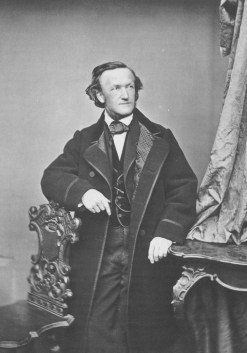
Richard_Wagner

When not busy falling in love, chasing stable boys or throwing money at Wagner, he commissioned the construction of two extravagant palaces and a castle.  Neuschawnstein Castle (b. 1869-1886) is probably the most well known castle in the world as it graces many a calendar and was an inspiration for the Disney logo.  It is built on the site of two twin medieval castle ruins – Vorderhohenschwangau Castle and Hinterhohenschwangau Castle.  It was built in the Romantic revivalist style (an imitation of 12th century architecture) and was meant to be the permanent private home of the king.  It was only completed a few months before his death and in the end, Ludwig II lived in the palace for a total of only 172 days.  Upon his death in 1886 it was opened to the public and has remained so ever since having seen some 60 million tourists in that time.  The king had received inspiration from visits to several other romantic revival styled castles in Germany and France.  The romantic interpretation of the Middle Ages, as well as the musical mythology of his friend Wagner, whose operas Tannhäuser, Lohengrin & Parsifal had made a lasting impression on him, and inspired the design of a knight’s castle.  The suite of rooms within the castle contain the Throne Room, Ludwig’s suite, the Singers’ Hall, and the Grotto.  The interior and especially the throne room are in the Byzantine-Arab style.  Throughout, the design pays homage to the German legends of Lohengrin and the Swan Knight.  Due to its secluded location, the palace survived the destruction of two World Wars.  During WW II it served as a depot for Nazi plunder that was taken from France.  In April 1945, the SS considered blowing up the palace to prevent the building itself and the artwork it contained from falling to the enemy.  The plan was not carried out and at the end of the war the castle was surrendered undamaged to the Allied forces.

In the forest above the Neuschwanstein Castle is the Queen Mary bridge (Marienbrücke).  It is named after Queen Marie of Prussia, the mother of Ludwig II and wife to King Maximilian II.  King Maximilian II constructed a wooden bridge in 1845 over the “Pöllatschlucht” (Pöllat Gorge) as a footbridge for riders.  It was later rebuilt by Ludwig II in iron as it is seen today.  It stretches 35 metres over the gorge at a height of 90 metres.  Interesting sensation to be out on the bridge with uncontrolled access of hundreds of tourists all vying to get out there at the same time.  Especially irritating are the ones with “selfie sticks.”  Once out there you receive a fantastic view of the castle, the gorge and the Lake Forggensee in the background.

In the Middle Ages, three castles overlooked the villages of Hohenschwangau.  One was called Schwanstein Castle.  In 1832, Ludwig II’s father King Maximilian II bought its ruins to replace them with the comfortable neo-Gothic palace known as Hohenschwangau Castle overlooking the Schwansee (Swan Lake) & Alpsee (Alp Lake).  The confusing result is that Hohenschwangau and Schwanstein have effectively swapped names: Hohenschwangau Castle replaced the ruins of Schwanstein Castle, and Neuschwanstein Castle replaced the ruins of the two Hohenschwangau Castles.  Finished in 1837, the Hohenschwangau Castle became his family’s summer residence, and his elder son Ludwig II (born 1845) spent a large part of his childhood here.  Ludwig’s childhood years here were very happy considering both his brother were basically abandoned and spent most of their time with their grandfather the abdicated King Ludwig I.  He lived for much of the time at the castle Hohenschwangau.  The castle is decorated in the Gothic Revival style with many frescoes depicting the heroic German sagas.

We did not visit the Hohenschwangau Castle instead deciding maybe on lunch near the Alpsee lake.  In the end we ended up returning to Füssen instead for lunch and a look around there.  It was may be a bit of a mistake as we were to find out.  Most things tend to be shut on Sundays in Bavaria including the supermarkets which for a tourist is rather inconvenient, how ever we managed to survive (see the next post on Füssen).

Posted in Germany, Travel blog | Tagged , , , , , , , , , , , | Leave a comment

Day 6 – Part 2: The Many Shires of Bavaria

This post will be somewhat shorter than the last and much lighter in temperament.  It was our pick-me-up after the burden of the negative, dark and overwhelming impressions of Dachau.  And just like that our brief visit to Munich was over and the afternoon would see us leave Munich and head for Füssen in the south western corner of Bavaria & Germany.  Munich was wonderful and I plan on coming back.  Steph had not joined Dave & I at Dachau as she had been to Auschwitz in Poland and instead decided to indulge her favourite passion for exotic animals at the Munich Zoo.  On departing Dachau, I had just written into the GPS “Munich Zoo.”  It came up that it was just 10 minutes away.  Thought it a bit strange as the zoo was on the other side of the city, but no worries off we went.  Ten minutes later we found ourselves parked outside a German animal supplies & pet store called Munich Zoo somewhere in the burbs.  We had traveled further from where we planned to be and it would take us another 40 minutes to reach Steph.  With Steph now on board it was time to visit the Shires (gau in German).

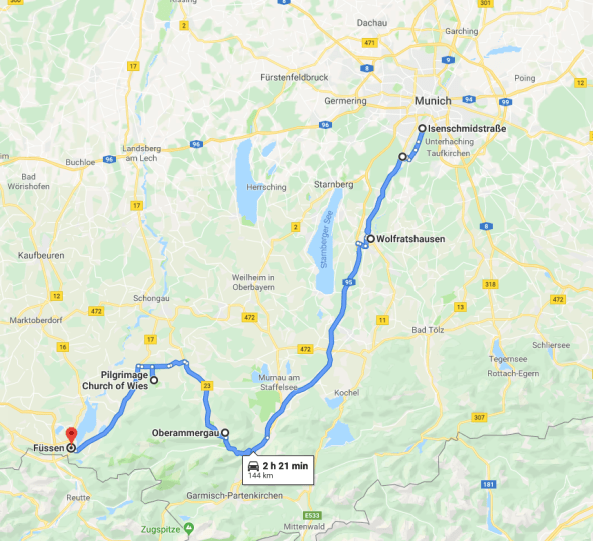
Munich to Fussen

First stop would be for a late lunch in Wolfratshausen.  As usual, the local Lidl supermarket proved to be the perfect place to pick up supplies.  Getting to be a bit of a habit on this trip.  So what is Wolfratshausen known for?  Not much really but a pleasant little river side village.  However, it does have one major place in history.   It was the sight of the Föhrenwald Displaced Persons camp in post-World War II, which was the largest in Europe and not closed until 1957.  Föhrenwald was transformed into a suburb of Wolfratshausen and renamed Waldram.  The older part of the town and the river walk made for a very pleasant break for lunch.

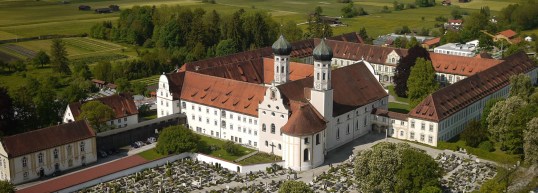
Close by to Wolfrathausen is the Benediktbeuern Abbey, a famous monastery formerly belonging to the Benedictine Order founded in 739.  While not visiting it, its name is well known because of the Carmina Burana (‘Benediktbeuern songs’) manuscript found there in 1803 and subsequently set to music by Carl Orff.  Carmina Burana is a manuscript of 254 poems and dramatic texts mostly from the 11th or 12th century.  The pieces are mostly bawdy, irreverent, and satirical (strange for an abbey manuscript 😀 ).  Twenty-four poems in Carmina Burana were set to music by Carl Orff in 1936.  His composition quickly became popular and has become a staple piece of classical music repertoire.  The opening and closing movement “O Fortuna” is the most used piece of music in films (click link).  Why do I mention it?  I have sung this piece 3 times and in one as part of the sextet singing “Si puer cum puellula.”  It is my favourite all time piece of classic music that I have performed in.

Benediktbeuern Abbey

Next stop on the trip was Oberammergau high in the alps near Garmisch-Partenkirchen. The small town on the Ammer River is known for its woodcarvers and woodcarvings, and for its 380-year tradition of mounting Passion Plays.  The Oberammergau Passion Play was first performed in 1634.  It resulted from a vow made by the inhabitants of the village that if God spared them from the effects of the bubonic plague that was sweeping the region they would perform a passion play every ten years.  A man traveling back to the town for Christmas had accidentally brought the plague with him.  The man died from the plague and it began spreading throughout Oberammergau.  After the vow was made, not another inhabitant of the town died from the plague.  All of the town members that were still suffering from the plague recovered.  The play is now performed in years ending with a zero, as well as at the 300th anniversary in 1934 and the 350th anniversary in 1984.  The 1940 performance was cancelled due to the Second World War.  The play involves over 2000 actors, singers, instrumentalists and technicians, and all the residents of the village.  The streets of central Oberammergau are home to dozens of woodcarving shops, with pieces ranging from religious subjects, to toys, to humorous portraits.  Oberammergau is also famous for its “Lüftlmalerei” or frescoes, of traditional Bavarian themes, fairy tales, religious scenes or architectural trompe-l’œil (3D perspective) found on many homes and buildings.

Try this for a German tongue twister: …Ob er aber über Oberammergau, oder aber über Unterammergau…

As I planned this trip I used Google maps to try and find the most interesting routes between our destinations to get the most out of our trip and to avoid boring autobahns.  As I was looking for a route between Munich and Füssen I stumbled across a site I never thought I would get the opportunity to visit – The Pilgrimage Church of Wies (Wieskirche).  I had seen it in TV documentaries and it fascinated me as I love Baroque & Rocco design.  It was miles off the beaten track but our planned route would just happen to take us past it on our way to Füssen.  Wieskirche is an oval rococo church designed in the late 1740s.  It is located in the foothills of the Bavarian alps.  In 1738, tears were seen on a dilapidated wooden figure of the Scourged Saviour.  This miracle resulted in a pilgrimage rush to see the sculpture.  In 1740, a small chapel was built to house the statue but it was soon realized that the building would be too small for the number of pilgrims it attracted, and so it was decided to commission a new church for the sculpture.  Many who have prayed in front of the statue of Jesus on the altar have claimed that people have been miraculously cured of their diseases, which has made this church even more of a pilgrimage site.  Construction took place between 1745 and 1754, and the interior was decorated with wonderful frescoes and stucco work in the tradition of the Wessobrunner School.  A quote from an unknown source summed it up: “Everything was done throughout the church to make the supernatural visible.  Sculpture and murals combined to unleash the divine in visible form.”  The Wieskirche was added to the UNESCO World Heritage List in 1983.

Our final destination for the day was Füssen where we would spent the next few nights.  On the outskirts we passed through the village of Schwangau (Swan Shire).  Schwangau is home to the two sites we came here to see – Schloss Neuschwanstein and Schloss Hohenschwangau.  As we trundled into Füssen as many other travellers had, we found we had come to the end of what had once been called the Romantic Road on the Grand Tour of Europe in the 1800s, which runs from Würzburg to Füssen.  I would be visiting both the start and finish of this route.  Anyway, tomorrow will be a fascinating day visiting one of the world’s most iconic sites.


Posted in Germany | Tagged , , , , , , | Leave a comment

Day 6 – Part 1: The Death Camps

WARNING: There maybe disturbing text & pictures in this post.  This was not an easy post to write.  Many thoughts and experiences are still swimming around in my head after having visited this place almost 9 months ago.

—————————————————————————————————————————

The plan for today was to visit the WWII Nazi Concentration Camp at Dachau on the outskirts of Munich.  What I experienced on this visit tests ones faith and trust in mankind to the very core.  It questions the sensibility & common sense of the individual, their ability to confront fear yet maintain dignity, and to say no when everyone else says yes.  It shakes your being both intellectually and emotionally.  Dave would later comment that it felt like the wind had been knocked out of him.  Powerful effects.

Dachau concentration camp was the first of the Nazi concentration camps and opened in 1933.  It was located in the grounds of an old abandoned munitions factory northwest of Munich.  It was opened by Heinrich Himmler for the purpose of holding political prisoners but it was later expanded to include forced labor, the imprisonment of Jews, German and Austrian criminals, and eventually foreign nationals from countries that Germany occupied or invaded.  The Dachau camp system grew to include nearly 100 sub-camps, where forced labour could be shipped from Dachau throughout southern Germany and Austria to be used where ever it was needed.  Dachau served as a prototype and model for the other German concentration camps that were to follow.  It was used to train SS guards for other camps and in fact the number of SS troops stationed here outnumbered the prisoners all most 2 to 1.  Newspapers continually reported the removal of the enemies of the Reich to concentration camps and as early as 1935, a jingle went around: “Lieber Herr Gott, mach mich stumm, Das ich nicht nach Dachau komm” (Dear God, make me silent, that I may not come to Dachau).

Dachau was the concentration camp that was in operation the longest from March 1933 to April 1945, nearly all twelve years of the Nazi regime.  From 1933 to 1938, the prisoners were mainly German nationals detained for political reasons.  After the Kristallnacht (Crystal Night), 30,000 male Jewish citizens were deported to Dachau and other concentration camps.  More than 10,000 of them were interned in Dachau alone.  As the German military occupied other European states, citizens from across Europe were sent to the camps.  Subsequently, Dachau was used for prisoners of all sorts, from every nation occupied by the forces of the Third Reich.  History will likely never know how many people were interned or died there.  Over the 12 years of use as a concentration camp, the Dachau administration recorded an intake of approx. 210 000 prisoners from more than 30 countries, of whom two-thirds were political prisoners (including many Catholic priests) and nearly one-third were Jews.  Some 32 000 prisoners are believed to have died in the camp and almost another 10,000 in its sub-camps.  Towards the end of the war, death marches to and from the camp caused the deaths of numerous unrecorded prisoners.  After liberation, prisoners weakened beyond recovery by the starvation conditions continued to die.

The prisoners of Dachau concentration camp originally were to serve as forced labour for a nearby munitions factory, and to expand the camp.  The prisoners’ entrance was secured by an iron gate with the motto “Arbeit macht frei” (“Work will make you free”). This reflected Nazi propaganda, which trivialized concentration camps as labour and re-education camps, when in fact forced labour was used as a method of torture and murder.  Over 4,000 Soviet prisoners of war were murdered by the Dachau Commandant’s Guard at the SS shooting range located two kilometers from the main camp in the years 1942/1943.  They were used for target practice.  These murders were a clear violation of the provisions laid down in the Geneva Convention for prisoners of war.  The SS used the cynical term “special treatment” for these criminal executions.  The prison enclosure at the camp was heavily guarded to ensure that no prisoners escaped.  A 3-metre-wide no-man’s land was the first marker of confinement for the prisoners; an area which upon entry would elicit lethal gunfire from the guard towers.  Guards were known to have tossed inmates’ caps into this area, and forced the prisoners to go fetch them resulting in their death by machine gun fire.  Pure entertainment!  Despondent prisoners often committed suicide by entering the zone.

In the last months of the war, the conditions at Dachau deteriorated.  As Allied forces advanced toward Germany, the Germans began to move prisoners from concentration camps near the front to more centrally located camps.  They hoped to stop the Allies finding out and to prevent the liberation of large numbers of the prisoners.  Transports from the evacuated camps arrived continuously at Dachau.  After days of travel with little or no food or water, the prisoners arrived weak and exhausted, often near death.  Typhus epidemics became a serious problem as a result of overcrowding, poor sanitary conditions, insufficient provisions, and the weakened state of the prisoners.  During April 1945 as U.S. troops drove deeper into Bavaria, the Commandant of Dachau SS-Obersturmbannführer Martin Weiss suggested to Gestapo Chief Heinrich Himmler that the camp be turned over to the Allies.  Himmler, in signed correspondence, prohibited such a move, adding that “No prisoners shall be allowed to fall into the hands of the enemy alive.”

On the 19th of April 1945, a freight train from Buchenwald on its way to Dachau with nearly 4,500 was diverted to Nammering.  SS troops and police confiscated food and water, which local townspeople tried to give to the prisoners. Nearly three hundred dead bodies were ordered removed from the train and carried to a ravine over 400 metres away.  The 524 prisoners who had been forced to carry the dead to this site were then shot by the guards, and buried along with those who had died on the train.  The train continued onto Dachau.  Once it arrived in Dachau it wasn’t even unloaded as the soldiers fled ahead of the arrival of U.S. troops.  Consequently, those remaining on the train died of exposure to the cold and lack of food & water.  On the 24th of April 1945, just days before the U.S. troops arrived at the camp, the Camp Commandant and a strong guard forced between 6,000 and 7,000 surviving inmates – on a death march from Dachau, south, deep into the alps.  Any prisoners who could not keep up on the six-day march were shot.  Many others died of exhaustion, hunger and exposure.  Months later a mass grave containing 1,071 prisoners was found along the route.  The SS offered little resistance as the Allies approached and on the 29th April 1945 the camp was surrendered to the allies.  American troops killed some of the SS camp guards after they had surrendered while others were grabbed by the internees and beaten to death.  So badly, they were unidentifiable afterwards and in some cases the body were ripped into pieces.

The Dachau complex included the prisoners’ camp, which occupied approximately 3 hectares, and a much larger area for the SS training school including barracks, factories & other facilities of around 9 hectares.  Outside the main gate was the railway platform to which the death trains arrived.  The prisoners would depart the train and enter through the gatehouse which bore the words on the gate “Arbeit macht frei,” then out onto the large parade ground called Roll-call Square in front of the large U-shaped Administration building with the words on the roof, “Es gibt einen Weg zur Freiheit. Seine Meilensteine heißen: Gehorsam, Ehrlichkeit, Sauberkeit, Nüchternheit, Fleiß, Ordnung, Opfersinn, Wahrhaftigkeit, Liebe zum Vaterland” (“There is one road to freedom.  Its milestones are: obedience, diligence, honesty, orderliness, cleanliness, truthfulness, self-sacrifice and love of the fatherland”).  The area was able to hold forty to fifty thousand persons and served mainly as the assembly point for the prisoner roll calls, during which the prisoners were counted every morning and evening, or for carrying out punishments.  They could be held here for hours in all kinds of weather.  From the parade ground they entered the administration building by the left hand side, to be identified and then passed through a series of rooms slowly being removed of personal possessions, stripped of their dignity, humiliated and degraded before returning to the parade ground to be sorted into groups and dispersed to the barracks according to the sorting system.

Dachau was mainly a camp for adult men, but there were a few children who were of Slavic decent.  The largest number of prisoners in the whole Dachau system were classified as political prisoners.  The majority of them were Catholic but also included Communists, Social Democrats, anarchists, spies, and anti-Fascist resistance fighters.  They came from the all the Nazi occupied countries such as France, Belgium, Norway, the Netherlands, and Poland.  The second largest group of prisoners were the Jews.  The third category of prisoners were the regular criminals who were considered too dangerous to return to society after they completed their prison sentence.  Finally the smallest group were the undesirables – they were homosexuals, Jehovah’s Witnesses, gypsies and anti-socials.  Each group and sub-group had their own colour codes of triangles and bars, and within the groups there was a hierarchy with often the yellow, black & pink triangles at the bottom.

  • Red triangle – political prisoners: social democrats, socialists, communists, anarchists, rescuers of Jews, trade unionists, Freemasons.
  • Yellow triangle – Jewish (was often used in combination with other triangles).
  • Green triangle – convicts and criminals
  • Blue triangle – foreign forced labourers and emigrants.
  • Purple triangle – Jehovah’s Witnesses as well as members of other pacifist groups.
  • Pink triangle – primarily homosexual as well as sexual offenders including rapists & pedophiles.  Prior to this dehumanising classification system, gay men were marked with a capital A, sewn onto their left breast or trouser leg.  This stood for Arschficker, the German for ‘arsefucker’.
  • Black triangle – people who were deemed anti-social elements, work-shy, Gypsies, mentally ill, mentally disabled, alcoholics & drug addicts, vagrants & beggars, prostitutes & lesbians
  • Brown triangle – Romani males.
  • Uninverted red triangle – a special enemy POW, a spy or traitor, a military deserter or criminal.

People who wore the green and pink triangles were convicted in criminal courts and after the camps were liberated were transferred to the post-war criminal prison systems.  Shocking for the pink triangles that even after all they endure at the hands of the Nazis they were further mistreated by the Allies!  Shame!

The concentration camp labels

Homosexuality was classed as a “degenerate form of behaviour” in Nazi Germany that threatened the nation’s “disciplined masculinity”.  Under Nazi law, homosexuality was deemed non-Aryan and as such homosexuals were far more persecuted in Nazi Germany than under previous regimes.  Ironically it had been the support of Ernst Rőehm, a known homosexual, and his SA followers that had greatly helped Hitler gain power on the 30th of January 1933.  Heinrich Himmler, estimated that there were 2 million homosexuals in Nazi Germany.  In a speech given to SS men in February 1937, he compared the campaign against homosexuals to be no different from digging up weeds in a garden.  During the speech, Himmler made it clear that if any SS man was found to be homosexual, he would be arrested, publicly humiliated, sent to a concentration camp where he would be deliberately shot trying to make a fictitious escape.

The layout of Dachau follows a very strict and precis order.  There were 34 barracks arranged in 2 rows of 17.  The barracks were designed to hold 6000 prisoners but held almost 30,000 by the end of the war.  The first four buildings were designated Blocks A, B, C & D.  Block A was the camp canteen; Block B the camp library; and, Blocks C & D the hospital & morgue.  Each of the remaining 30 barracks was designed to accommodate 180 prisoners with 90 men in each section.  There were two living rooms and two dormitory rooms in each section.  Each dormitory room had 15 three-tiered bunks with a total of 45 beds.  Blocks A & B have been rebuilt to show us what conditions were like in the original barracks.  The original barracks were demolished in 1964 due to decay.  The foundation foot-prints of the other barracks however remain as a monument to those who lived in them.  Some of the more infamous barracks were: Barrack 9 – the quarantine for newcomers;  Barracks 2 & 4 were for German prisoners;  and the catholic priests were housed in Barracks 26 & 28 (Priesterblock) at the northern end of the camp.  Some barracks gained notorious reputations.  Barrack 30 was for the invalids who couldn’t work (the barrack closest to the gas chamber & crematorium).  Barracks 15, 17 & 19 were the punishment blocks (Strafblöcke).  Barracks 1, 3, 5, 7 & 9 were where the horrific medical experiments were carried out.  Barrack 15 was reserved for the Jews who were kept isolated from the other prisoners.

Prisoners lived in constant fear of brutal treatment and terror detention including the standing cells.  These were stone chambers similar to chimneys and measured 75 x 80 cm with a small hatch on top for air.  It was impossible to sit down.  Prisoners who had been condemned to this punishment were put into a standing cell for 72 hours at a time with no light or air.  The prisoner was compelled to stand for three days and three nights and was given only bread and water.  Every fourth day they were shifted to a normal cell, allowed to eat a normal prisoner’s meal and to sleep for one night on a bed.  Then the next three days’ of the standing punishment would begin again.  This was repeated over and over again until their sentence was completed.  There were floggings where the prisoner was stretched over a table and caned across the back and lower limbs.  In some cases there was barely any skin left on the prisoner’s back.  Tree or pole hanging was a particularly brutal form of punishment.  The victim’s hands are tied behind their back and they are suspended by a rope attached to the wrists, typically resulting in dislocated shoulders.  Weights were some time added to the body to intensify the effect and increase the pain.  This kind of torture would not last more than an hour because without rest, it was likely the prisoner would die.

Punishment by flogging

Hundreds of prisoners suffered and died at the hands of the SS in medical experiments conducted at Dachau.  Doctor Sigmund Rascher was one of the doctors in charge of these facilities.  Hypothermia experiments where prisoners were exposed to vats of icy water or being strapped down naked outdoors in freezing temperatures.  Attempts at reviving the subjects included scalding baths.  High altitude experiments were also conducted. Victims were subjected to rapid decompression from pressures found at 4,300 metres to ground pressure where they experienced spasmodic gasping convulsions and eventual death.  The experiments were meant to help provide information on how pilots could survive bailing out at altitude or landing in water.  Rascher also experimented with the effects of Polygal, a substance made from beet and apple pectin, which aided blood clotting.  He predicted that the preventive use of Polygal tablets would reduce bleeding from gunshot wounds sustained during combat or during surgery.  Prisoners were given a Polygal tablet and shot through the neck or chest or even had their limbs amputated without anaesthesia to see if the tablet helped in stopping the bleeding.

Another infamous area of the camp was the Bunker & Courtyard.  This was an area secluded behind the Administration building separate from the barracks area.  The bunker had 136 prison cells.  Detention in the bunker was a method that enabled the SS to isolate rebellious and defiant prisoners.  To confine and expose them to harsher prison conditions out the reach of their fellow prisoners and to torture or indeed murder them.  The bunker was used from 1938 to 1945 to incarcerate high-level “enemies of the state.”  Several cells at the west end were set aside for “honor prisoners” who were high-ranking clergymen or important political prisoners.  They did not have to work and were not subject to punishments.  Their cells were often left unlocked.  These privileged prisoners who lived in the bunker had access to a grassy courtyard where they could walk around and receive visitors.  They were well treated because the Nazis viewed them as possible hostages and bargaining chips with the Allies.  At the eastern end of the courtyard between the Administration building and bunker is a wall where prisoners were hung or shot by firing squad.  There was even a special wing set aside for camp guards who had broken the strict rules of the SS, and Police officers & Air Raid Wardens who failed in their duties.  The former SS prison has been demolished as the Memorial Site is devoted to the victims and not the perpetrators.

Several prominent individuals were held in the bunker: Catholic Cardinals & Bishops, members of the Austrian, Bavarian & Prussian Royal families (who were ardent anti-Nazi); the captured Greek Military leadership, prominent writers of the time; and German Generals of the Old Wiemar Republic who opposed Hitler.  Many resistance leaders were brought to the bunker and tortured.  A future Nobel laureate in Physics in 1992, Georges Charpak, was imprisoned here after being captured in France.  Georg Elser who almost succeeded in killing Hitler in the Bürgerbräukeller (a large beer hall in Munich) by implanting a time bomb in a pillar just behind Hitler’s podium.  Hitler escaped death by sheer luck.  That night for some reason he cut his rambling speech short from 2 hours to 1, and left before the bomb went off killing many others.  Georg was shot in one of the bunker cells after horrific torture that went on for months over the 5 years of his incarceration.  One of the most notable incidents involving Allied POWs was the execution of the four Special Operations Executive (SOE) women who had worked for the French resistance including the famous Noor Inayat Khan.  On the September the 12th, 1944 they were taken to the crematorium and shot, then disposed of in the furnaces.  After the war, German war criminals were imprisoned in the Dachau bunker during their war crimes trials and it was often the site of their execution.  Many infamous Nazi names were associated with the site:  Himmler, Eichmann, Wiess, Höss, Hintermayer, Schumann, Rascher and many more.

In the far north western corner of the camp is Barrack X with its gas chamber and crematoria which had been constructed to dispose of the dead.  The prisoners entered through a door on the south side and proceed through the waiting room, and then into the undressing room before entering the gas chamber.  The room was disguised as “showers” and equipped with fake shower heads to mislead the victims and prevent them from refusing to enter the room.  During a period of 15 to 20 minutes up to 150 at a time could be suffocated to death by prussic acid poison gas (Zyklon B) in the chamber.  The bodies were then removed into the next room for storage until the furnaces could take them.  The furnaces operated day and night.  By the end of 1944, the furnaces lacked the capacity to cremate the scores of dead from the camp.  Upon liberating the camp at the end of April 1945, American soldiers came across countless corpses piled up in the crematorium.  Barrack X is a horrific building to be inside of and I couldn’t wait to get out of the place.  It left me physically and emotionally shaken.  The area surrounding the barracks has been turned into lovely memorial gardens.  The gardens rest upon the ash piles of the thousands who perished in Barrack X and the greenery veils the walls where some were shot.

Barrack X - Gas chamber

Our visit to the camp ended in front of the Administration building as it had begun.  In front of the International memorial.  The International monument is made up of 3 parts on the gravel parade ground:  the East, the West and the Centre.  On the west side is a wall whose inscription in English reads “May the example of those who were exterminated here between 1933 and 1945 because they resisted Nazism help to unite the living for the defense of peace and freedom and in respect for their fellow men.”  In the centre, is a sculpture made of dark bronze by Nandor Glid.  It features short strands of barbed wire on which skeletons are hanging with their heads dangling.  On either side of the sculpture are concrete fence posts which closely resemble the ones actually used to support the barbed wire fence around the camp.  On the wall of the ramp down to the sculpture is another sculpture which features a base relief depicting three links of a chain held together by bars in between.  This signifies the unity among the prisoners, many of whom were political prisoners who shared the same beliefs.  On the links are enameled triangles in the colors of the cloth badges worn by the prisoners on their uniforms to identify their prisoner classification.  On the east side, are words on a wall saying “Never Again” in five different languages.  In front of this wall is a box of ashes of the victims of the Dachau concentration camp.

The only fitting way I see of finishing this episode in my blog is to leave you with the words of those who survived lived it:

“Monsters exist, but they are too few in number to be truly dangerous. More dangerous are the common men, the functionaries ready to believe and to act without asking questions.”Primo Levi

“When their bodies had finished scouring for gaps in the door, their souls rose up.  When their fingernails had scratched at the wood and in some cases were nailed into it by the sheer force of desperation, their spirits came toward me, into my arms, and we climbed out of those shower facilities, onto the roof and up, into eternity’s certain breadth.  They just kept feeding me.  Minute after minute.  Shower after shower.” Markus Zusak, The Book Thief

The the loudspeakers broadcast some noisy classical music while the SS stripped him naked and shoved a tin pail over his head. Next they sicced their ferocious German Shepherds on him: the guard dogs first bit into his groin and thighs, then devoured him right in front of us.  His shrieks of pain were distorted and amplified by the pail in which his head was trapped.  My rigid body reeled, my eyes gaped at so much horror, tears poured down my cheeks, I fervently prayed that he would black out quickly. – Pierre Seel; I, Pierre Seel, Deported Homosexual: A Memoir Of Nazi Terror

“First they came for the socialists, and I did not speak out—because I was not a socialist. Then they came for the trade unionists, and I did not speak out—because I was not a trade unionist. Then they came for the Jews, and I did not speak out—because I was not a Jew.  Then they came for me—and there was no one left to speak for me.” – Martin Niemöller

For evil to flourish, it only requires good men to do nothing.” – Simon Wiesenthal

As observed in 1935, the homosexuals `lived in a dream’, hoping that the heyday of gays in Germany of the 1920s would last forever.  Their awakening was terrible.  Yet, the few survivors among them did not qualify for postwar restitution as the Jews or the politicals, because as homosexuals they were outside the law.  – Lorant, Stefan, I Was Hitler’s Prisoner

Jews, homosexuals, and Gypsies, the yellow, pink and brown triangles, were the prisoners who suffered most frequently and most severely from the tortures and the blows of the SS and the Capos. They were described as the scum of humanity, who had no right to live on German soil and should be exterminated… but the lowest of the low in this “scum” were we, the men with the pink triangle. ― Heinz Heger, The Men with the Pink Triangle: The True Life-and-Death Story of Homosexuals in the Nazi Death Camps

May they never be forgotten, these multitudes of dead, our anonymous, immortal martyrs.” ― Heinz Heger, The Men with the Pink Triangle: The True Life-and-Death Story of Homosexuals in the Nazi Death Camps

Posted in Germany, Travel blog | Tagged , , , , , , , , , , , , , , , | Leave a comment

Day 5 – Salt, Steins & Schweinshaxe

Today we leave the lovely environs of Salzburg and head to the beer drinking capital of the world, Munich.  I promised myself I will be back to Salzburg.  I have to fulfill my dream of attending a Mozart concert or opera here.  Steph decided on one of the day’s activities, she wanted to head underground ??????? Hi ho, hi ho, off to the Hallein Salt mines we go.

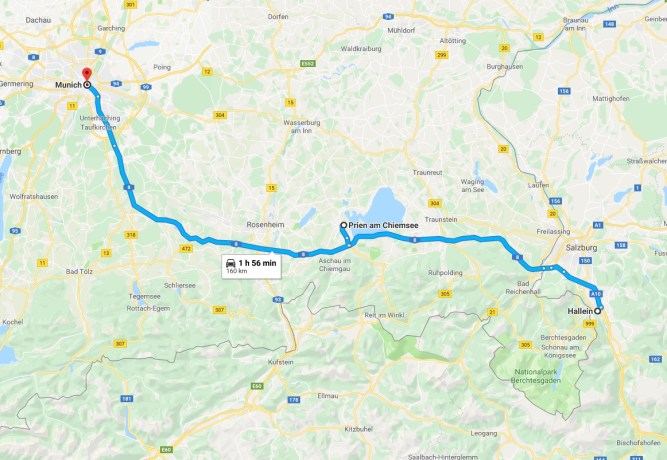
Hallein to Munich

As mentioned earlier, salt has played a big part in the history of this area of Austria & Salzburg, and the only place to find it is underground.  The Hallein Salt mine goes deep into the Dürrnberg mountain.  Miners have hauled out the “white gold” from here for over 2500 years.  The value of salt has at times rivaled that of precious stones such diamonds.  Early mining was done by hand and extracted salt rock crystals.  The miners had to slide in and climb out.  Those who died in the mine were dried out and mummified by the salt and over time the salt engulfed them as evidenced by the “Salt Mummie.”  To improve efficiency, fresh water was pumped down into a cavern.  After several weeks of absorbing salt from the walls, the water was pumped out to a processing plant in Hallein and recrystallized.  Visitors to the mine don white overalls to protect their clothes while inside the mine, then take an electric train 400 metres into the mountain.  From there you wander through the tunnels and twice you have to take wooden slides, each 42 metres long, down to the lower levels of the mines.  Visitors straddle two wooden rails and slide down.  This was how the miners used to do it, like sliding down the banister.  At one point, the mine actually crosses under the border between Austria & Germany into Bavaria.  You reach the lowest point in the mine 210 metres underground and arrive at a lake of salty brine.  You cross the lake by boat before taking an escalator back up to the train to exit the mine.  Salt was responsible for the immense wealth of the Salzburg Prince Archbishops; those natural salt deposits were very much the treasure chamber of the Salzburg region.  The Prince Archbishops – especially Wolf-Dietrich von Raitenau, (1559 to 1617) – used the massive profits from the salt trade for many different purposes, but especially to create the baroque buildings of the city of Mozart. Great activity, warmly recommended.
Time to bid Austria farewell for this visit and head towards Munich.  Next stop, lunch on Lake Chiemesee, often called “the Bavarian Sea.”   There are three islands on the lake Herreninsel (the largest “gentlemen’s island”), Fraueninsel (“ladies’ island”) and Krautinsel (“Cabbage Island”; as in Sauerkraut).  On Herreninsel is a palace built by King Ludwig II of Bavaria in 1878 called HerrenchiemseeIt was never completed because the King died but it was meant to be a replica of the Palace of Versailles.  King Ludwig II is sometimes called the Swan King or the Fairy Tale King.  He succeeded to the throne aged 18 and is often said to be the mad King.  Ludwig II increasingly withdrew from day-to-day affairs of state in favour of extravagant artistic and architectural projects.  He commissioned the construction of two lavish palaces; Linderhof Palace and Neuschwanstein Castle (will tell you more of that in a future post) and he was a devoted patron of the composer Richard Wagner.  Ludwig II spent all his royal revenues on these projects, borrowed extensively, and defied all attempts by his ministers to restrain him.  This extravagance was used against him to declare him insane.  It lead to angry ministers & doctors managing to section and detain him.  He came to an abrupt end at the age of 40 while on a evening stroll with his doctor by the lake in the grounds of one of his palaces.  Both he and his doctor were found dead in knee deep water.  Theories have ranged from foiled escape plans, to suicide and murder.  The mystery remains.  Today, his architectural and artistic legacy are some of Bavaria’s most important tourist attractions; the Herrenchiemsee palace among them.  I would have loved to see it but time was limited and a thunder storm was brewing on the horizon.  We found a lovely place on the shore of the lake to have a picnic.  While away at the car I missed all the action.  Apparently, a couple on the picnic blanket beside us got a visit from a snake which sent everyone scrambling.  On returning, I found we had moved a sufficient distance further along the shore.  In order to avoid being struck by lightning or drenched to the skin we decided the car was a safer place and we might as well hit the autobahn to Munich.  Don’t know if that was such a good idea.  We might be dry but it was horrific trying to drive as the volume of rain reduced the visibility to only a few metres.  Thank god we managed to eventually get ahead of it.

We arrived into Munich (Germany’s 3rd largest city) late in the afternoon.  After having planned to stay in the same hotel (even though we checked thoroughly with one another while booking separately) we found there were actually in 2 different hotels by the same name (Smart Stay Hotel).  I ended up about 2 km from Dave & Steph in a quiet residential area near the Oktoberfest park (Theresienwiese) while they were stuck in the inner city near the train station.  It made for a lot easier parking of the car where I was.  Anyway, after a refreshing beer it was time to take an evening stroll through the old part of the city.

Munich is a large city of 6 million but it is easy to navigate around (even by car).  Munich simply means “by the monks.”  A Benedictine Monastry established here in the 1100s on the salt road from Salzburg lead to the emergence of a settlement here as everyone had to pay the tolls to the monks to cross the river Isar.  Munich was the home of the Bavarian Kings until they were disposed following World War I.  The Communists took power and formed the Soviet Republic of Bavaria but that only lasted a couple of years.  Lenin had lived in the city while in exile before returning to Russia hence the Soviet connection.  The Wiemar republican government drove the German Soviets out, however Munich became a hotbed of extremist politics, and among which Adolf Hitler and the Nazis would soon rise to prominence.  The first attempt of the Nazi movement to take over the German government was in 1923 with the Beer Hall Putsch was stopped by the Bavarian police.  The revolt failed, resulting in Hitler’s arrest and the temporary crippling of the Nazi Party.  The city again became important to the Nazis when they took power in Germany in 1933 and Munich was declared their “Capital of the Movement.”  The party created its first concentration camp here on the outskirts of the city at Dachau.  The city is also known as the site for the culmination of the policy of appeasement by Britain and France leading up to World War II.  It was in Munich that British Prime Minister Neville Chamberlain assented to the annexation of Czechoslovakia’s Sudetenland into Greater Germany in the hopes of sating the desires of Hitler’s Third Reich.

Munich was also the site of the 1972 Summer Olympics, during which Israeli athletes were assassinated by gunmen from the Palestinian “Black September” group who took hostage members of the Israeli Olympic team.  The 1980s brought strong economic growth, high-tech industries and scientific institutions.  Munich is also a major European cultural centre and has played host to many prominent composers including Mozart, Wagner, Mahler, Strauss, and Carl Orff.  Some of classical music’s best-known pieces have been created in and around Munich by composers born in the area, for example Richard Strauss’s Also sprach Zarathustra or Carl Orff’s Carmina Burana which I sang recently.  I learnt just a week ago my baritone friend Martin Snell will be taking up residence at the Bavarian State opera in Munich.

Munich is probably best know for Oktoberfest which actually occurs in September and finishes on the first Sunday in October.  Around 6 million visit the fest over the 2 weeks with some 7.7 million litres of beer being drunk.  It is held in Theresa’s meadows (Theresienwiese).  The name of the site is derived from the name of Princess Therese of Saxe-Hildburghausen, the wife of Crown Prince Ludwig I.  Their wedding took place on the Theresienwiese in 1810 and since then, the Oktoberfest is celebrated every year to commemorate this event.  I preferred the quiet open space when I visited it.

We took a wandered along the Kaufingerstrasse walking street (part of the old salt road from Salzburg) into the Alstadt (Old City), passing the Michaelskirche (St. Michael’s Church; b. 1590s) a large renaissance church and burial site of Bavarian Dukes & Kings.  On past the Frauenkirche (Cathedral of Our Lady; b. 12th century) Munich’s best known building with a capacity to house 20,000 people standing, and finally arriving at the Marienplatz (St. Mary’s Square) in the centre of the city.  The square has been the here since 1158 and gained its name after the column to St. Mary erected in 1638 to celebrate the end of Swedish occupation by Gustav II Adolph (the Swedes got around 400 years ago).  The square is dominated by the New Town Hall (Neues Rathaus; b. 1870s) with its glockenspiel in the tower and the Old Town Hall (Altes Rathaus b. 1300s).

It was a warm summer Friday night so what better place to end the day and the week with a visit to a Beer Hall just like all other hard working Germans.  When in Germany, do as the Germans do!  And where is the best place to go?  Of course the Hofbräuhaus am Platzl (b. 1589) arguably the most famous beer hall in the world.  All of the rooms except the historic beer hall were destroyed in the World War II however it reopened after being restored in 1958.  Mozart is claimed to have written the opera Idomeneo after several visits to the Hofbräuhaus fortified him for the task.  With it cavernous vaulted halls, seating for 1300, baroque frescos all over the ceilings, muscle bound waitresses in traditional dress bearing 6, 7, 8 one litre steins and waiters serving traditional fare of pretzels, cheese dip, bratwurst & Haxe’n; we were in for a good night.  This was my bucket list appointment with a stein and Schweinshaxe with knödel (pork shank & potatoe dumpling) in Munich!  Of course the atmosphere would not be complete without an “ompa pumpa” orchestra (click) belting out beer hall favourites and people singing along.  A large number of people came dressed in traditional lederhosen (men) & dimdl (woman).  I was surprised how many wore the traditional dress as everyday clothing.  The large amount of steins that passed around the hall during the evening lead me to ponder on the equation of “beer in, beer out” while visiting the gents.  The diameter of the drains must be enormous.

With a great evening being had by one and all, it was time to wander back to the hotel and prepare for tomorrow’s more sobering activities.  Good night.

Posted in Austria, Germany, Travel blog | Tagged , , , , , , , , , | 1 Comment

Day 4 – The Infamous Berghof & Kehlsteinhaus


Good morning! Another brilliant day! Dave & Steph must have had too much sleep for they were already at my hotel rearing to go before I had even finished breakfast.  Today’s destination is one of Dave’s bucket list adventures.  You could see he was already well-read on his destination as the facts flowed hard and fast, and was accepting no excuses as to why we were wasting time when we could be on the road heading there.  Eager beaver, not easy having an excited 50+er in the car!  Are we there yet? 😀 😀

Today, we are heading south, leaving Austria for the day and heading into the Bavarian Alps to Berchtesgaden.  An area of natural beauty with the Watzman towering over the valley (3rd highest mountain in Germany) and below it the beautiful Königsee lake.  This would win over any tourist but because of one mad man it has become famous for many other reasons.  The drive from Salzburg is only about 30 km passing through beautiful landscape along the Berchtesgaden Ache river as the hills rise higher and higher eventually turning into mountains.  Arriving into the village of Berchtesgaden (700 m), it was just as a Bavarian village would look on a postcard.  The village clings to the wall of the valley with the town centre being dominated by the large square, church spires and the Schloss Brechtesgaden (a hunting and summer palace for the Bavarian Kings and Dukes).  The village is surrounded by high summer meadows which turn into ski-fields in the winter.  After a quick visit to the local tourist bureau to find out how to get up to the Eagle’s nest, we found we could drive up to Obersalzberg where we would have to leave the car and then take a bus the rest of the way up to the Eagle’s nest.  I may have a peppy little 2.0 litre sports car but it was a pull up those steep serpentine roads at times.  God knows how the Third Reich logistics worked to get everything up there.

Having made it up to the Obersalzberg (1100 m) it was time to take a step back to what happened here in the 30s & 40s.  The area was originally salt mines (Obersalzberg = upper salt mountain) however it became uneconomic in the 1800s and the area became more attractive to those wanting a winter and summer holiday destination.  It was popular with German intellectuals, musicians & artists with the Obersalzberg Boarding House being particularly popular.  The scenic landscape and sweeping mountain views also attracted Adolf Hitler, who in 1923 visited the Obersalzberg Boarding House.  He became so fond of the area that in 1928 he began renting a small chalet there.  Several months after the Nazi seizure of power in January 1933, Hitler purchased the Haus Wachenfeld chalet and began making a series of renovations and by 1936 the once modest chalet had been transformed into a sprawling landhaus.  The house became known as the Berghof or Mountain Court, and is not be confused with the Eagles Nest (Kehlsteinhaus).  From 1937 the German Reich Chancellery maintained a place here with Hitler receiving numerous guests of state at the Berghof including Neville Chamberlain (British PM) and the Duke of Windsor.  Hitler spent much of August 1939 at the Berghof, making final plans for the invasion of Poland.

Around Hitler’s home, several Nazi leaders such as Hermann Göring, Martin Bormann and Albert Speer acquired residences.  Party Secretary Bormann used intimidation & fear to buy or drive out all the residents of Obersalzberg, and the area evolved into a retreat for high-level Nazis with a school for young children, an SS barracks, and an underground bunker network & hospital.  The Berghof became something of a German tourist attraction during the mid-1930s.  This led to the introduction of severe restrictions on access to the area and other security measures.  A large contingent of the 1st SS Panzer Division Leibstandarte SS Adolf Hitler was housed in barracks adjacent to the Berghof as his personal bodyguards.  They patrolled the cordoned off security zone that encompassed the Berghof and the nearby homes of the other Nazi leaders.

With the outbreak of war extensive anti-aircraft defences were installed, including smoke generating machines to conceal the Berghof complex from hostile aircraft.  The nearby Hotel zum Türken was turned into quarters to house the Reichssicherheitsdienst SS security men who were Hitlers personal bodyguards and patrolled the grounds of the Berghof.  Several mountain troop units were also housed nearby.  Hence, the British never planned a direct attack on the compound for it was too well fortified.  In 1941, Hitler transformed the Obersalzberg into the alpine fortress where he had originally intended to make his final stand.  Hitler’s last known visit to the place was on 14th July 1944 and he would be dead by April 1945.

In 1938, Bormann had the Kehlsteinhaus lodge (1835 m; the teahouse on Kehlstein mountain more commonly known as the Eagle’s Nest) erected on a rocky promontory, including a tunnel and lift system to get up to it.  It was presented to Adolf Hitler in 1939, on his 50th birthday, but he only visited the site on 14 occasions, because of his fear of heights and being struck by lightning.  His mistress Eva Braun used it more frequently for her family and friends.  It was used for Nazi Party meetings and to host dignitaries, however the building had no beds so was only used for receptions.  The Eagle’s nest is reached by taking a road which climbs 800 m over 6.5 km arriving at the entrance to the tunnel.  The building is entered by taking the 131 m long tunnel from the car park into the mountain.  You arrive into a circular art deco styled reception room where guests would wait before being ushered into the ornate brass and glass elevator to be hoisted the 124 metres into the centre of the building.  It is still the same lift used today.  Visits to the Eagle’s nest were carefully choreographed to make the greatest impression possible.  Hitler refused to take the lift himself so used a mountain path to climb up to or descend from the lodge to the tunnel entrance.  The Eagle’s Nest pretty much resembles how it was in 1939 with the exception of a restaurant which has taken over the reception rooms.  The building is surrounded on three sides by massive precipices which drop several hundred metres to the valley floor.  The Eagle’s nest was used by the Allies as a military command post until 1960, when it was then handed back to the State of Bavaria.

The Berghof and the surrounding area were heavily damaged by an Allied air raid in April 1945.  Four days after Hitler’s suicide in Berlin, retreating SS troops set fire to the Berghof as Hitler had previously ordered.  Hours later, the U.S. and French forces arrived and the Obersalzberg was placed under U.S. administration.  At the time, the Berghof still contained destroyed paintings, evening gowns, medical equipment, and a wine cellar.  The house was stripped and looted by the Americans.  The Berghof’s shell survived and had attracted tourists until 1952 when the Bavarian government decided to demolish the buildings so they would not become a Nazi shrine.  As well as the Berghof, the houses of Göring and Bormann, the SS barracks, the Kampfhäusl, and the Mooslahnerkopf teahouse were all destroyed.  In total, over 50 Obersalzeberg Nazi buildings were destroyed.  The Mossslahnerkopf teahouse was Hitler’s favourite and he preferred it over the Eagle’s nest teahouse.  It was located across the valley from the Berghof and he walked to it everyday to spend time thinking and looking out over the valley.  When wandering the area of the Obersalzberg it is not easy to find the site of the Berghof.  It is not marked by any signs and has become overgrown by trees, however Dave & I persevered and with a little help from the internet and a friendly fellow tourist, we found ourselves standing where the main reception room had been and the view it encompassed.  The only remaining signs of it are the back walls of the Berghof still embedded in the hillside.

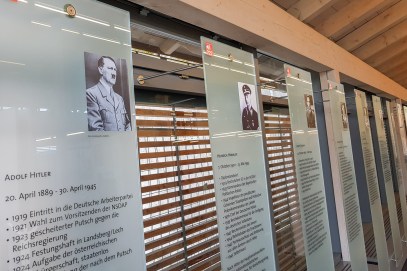
The Platterhof, which had been a hostel for visitors to the area, was not destroyed and was turned into a hotel after the war.  It was demolished in 2001.  The nearby Hotel zum Türken, used by the SS was badly damaged in 1945 but it was rebuilt in 1950 and reopened as a hotel.  The nearby Dokumentationszentrum Obersalzberg museum, opened in 1999, providing historical information on the use of the mountainside retreat during the war, and about the history of National Socialism.  Visitors can also tour the bunker complex however it was closed to us due to rebuilding which had been ongoing for the past year.  The museum displayed many documents & photos from the war.  There was one display that showed the 10 highest ranking Nazis.  They were all my age or younger, which shocked me.

Dokumentation Obersalzberg display

Having thoroughly explored the place it was time to head down into the valley but one could not visit here without making some kind of reflection on what had taken place here.  Among so much natural beauty how could these individuals plan such brutality on their fellow man?  As I sit and write this, news has reached me of the terrorist act which has taken place in my homeland of New Zealand.  The same reflective thought once again comes up.  How can it happen in my beautiful homeland?  Unfortunately, it looks like the world is about to repeat the mistakes of the 1930s and 40s made here in Obersalzberg.  Right wing politicians and dictators such as the late Austrian politician Jorg Haider, Hungry’s PM Viktor Orban, Poland’s President Andrzej Duda, US President Donald Trump, Turkey’s President Recep Erdogan, Syria’s Assad, Venezuela’s Maduro are doing just that governing by intimidation and fear.  Hatred and intolerance for our fellow man has to be stamped out.  Learn the lesson of Germany and don’t follow like sheep a mad man.

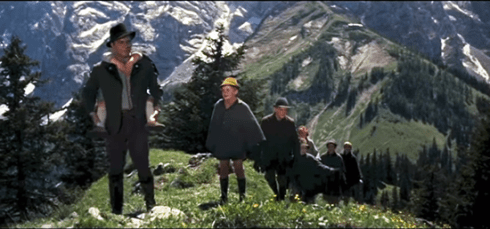
To end our visit on a happy note; the Obersalzburg was also the sight for the filming of The Sound of Music film’s last scene where the von Trapps were escaping into what was supposed to be Switzerland and to their freedom.  If you Climb Every Mountain here you will arrive in either Austria or Italy and the von Trapps would have been back in the war again.  Escaped from nothing. 🙂

Final scene - Sound of Music - Obesalzberg

We headed further up the valley to the beautiful lake called the Königsee (King’s Lake) for lunch.  I wondered why this name rung a bell and for a start I could not place it.  However, it soon became obvious when I saw the bobsleigh/luge run and remembered many a winter afternoon in front of TV watching the sport from here.  Heinrich Himmler also had a residence built here in nearby in Schönau and had located a sub-camp of the Dachau concentration camp here as a source of slave labour.

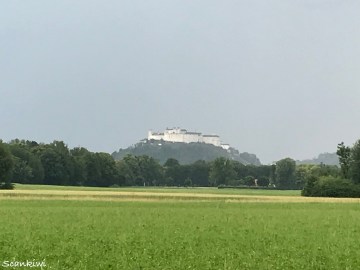
Long day done; Dave can tick one off his bucket list; time to head back to Salzburg for our last night before heading to Germany again tomorrow and Munich.  As we returned to Salzburg we were treated to a lovely view of the Hohensalzburg fortress sticking up out of the landscape.

Hohensalzburg

Posted in Germany, Travel blog | Tagged , , , , , , , , | Leave a comment

Day 3 – The Home of Mozart

Good morning Salzburg!  I almost expected to wake to the sounds of the Von Trapp family or melodies from the Magic Flute  🙂  Quick check of Viber to find Dave & Steph made their 2 am bus from Ljubljana and would be arriving Salzburg around 11 am.  A few hours for me to explore the city on my own on a fantastic beautiful sunny morning.

My hotel was (25 mins walk/3km) on the south side of the city centre.  As I said in my last post I was surprised by how small and flat the city was.  I must modify that statement by adding there is a bloody great rock in the middle which splits the city in two and I of course was on the wrong side of the Festungsberg (the rock) from the city.  Fortunately, there was a tunnel through it which meant I avoided having to climb up and over it.  The plan for the day was to walk into the city and tour the sights.  Chance to stretch the legs after 1200 km sitting in the car for the last 2 days.  Just have to mention my hotel, the Snooze Hotel Salzburg.  It is a little something special design wise both inside an out.  Amazing what you can create furniture-wise with sheets of MDF.  If anyone else was in the room and you were using the toilet or shower, you would be in full view due to glass doors and walls. 😀  Anyway off to the city.  By the way, today is also Sweden’s National Day, the 6th of June, and low and behold as I was walking into the city I came across Schwedenstrasse.  How fortuitous!

After my walk down to the city, I emerged through the tunnel, to exactly what I had imagined it to be like.  For once my preconceived notions of how a city I had heard so much about was so like how I imagined it.  I was greeted by views of fantastic Baroque architecture, gardens, alps and the skyline dominated by the Hohensalzburg Fortress.  As I wandered through the Alstadt (old city) I could only marvel that I was here in the city of my long time favourite composer – Mozart, and with that I found myself standing outside the house he was born in.  As I crossed the river to the other half of the old city the tourist app on my phone informed me that:  Salzburg literally means “salt castle.”  The name coming from the barges carrying salt on the River Salzach, which I was now crossing, on their journey down to the Danube and onto foreign destinations.  The area in the alps surrounding Salzburg are filled with old salt mines (more of that in a future post) and from it the city derived its wealth by strictly controlling the industry.  My continued meanderings lead me to Makartplatz (named after Hans Makart the Austrian painter which I like) where I found myself now in front of Mozart’s home where he wrote most of his music and raised his family.

On Makartplatz I found these small brass plaques mounted on street stones.  As I was examining them someone noticed and explained them.  He informed me that these small brass plaques were called stumbling stones (Stolpersteine) and were mounted in the pavement in front of houses of residents (mostly Jewish) who were persecuted or murdered by the Nazis.  The plaques mention their name, date of birth and the place of their death (mostly a concentration camp) and the date of their death.  The stumbling stone project was initiated by the German artist Gunter Demnig in 1992 and aims to commemorate individuals at exactly the last place of their residency or work before they fell victim to the Nazi terror.  The stones protrude slightly leading to the chance you might stumble.  By stumbling over it you learn of what happened to those who lived here.  The English adage, “to stumble onto something.”

Stumbling stones

From Makartplatz you can enter directly into the gardens of the Mirabell Palace.  The palace was built about 1606 by the Prince-Archbishop Wolf Dietrich Raitenau.  The Archbishop suffered from gout and had a stroke previously, so to avoid the narrow streets and steep inclines to the Hohensalzburg, he decided to erect a pleasure palace for himself and his mistress Salome Alt.  As I entered the beautiful gardens, I was entreated to the lyrical strains of Mozart coming from one of the windows in the buildings surrounding the gardens.  Ideal spot to sit and rest and check on the Coubroughs’ progress, who by now had arrived on the outskirts of the city.  Time to make my way to their hostel and meet up.  The last time was 3 years earlier in Earls Court, London, so it was with eager anticipation I made my way to their hostel.  As I left the gardens I was treated to a wonderful view of the Hohensalzburg.

Reunions made, it was time for lunch, a stein and a bloody good catch up.  Well feed and lubricated, Dave & I decided to hit some more sites, however Steph decided to catch up on some sorely lost sleep.  Our main goal was to make it up to the Hohensalzburg fortress.  But before that a little history.  Salzburg was the seat of the Prince Bishops (Rulers) of Salzburg as part of the Holy Roman Empire.  Ownership of the city has swung back and forth between independence, Bavaria & Austria, and eventually after WWI becoming part of German Austria.  Following the the Anschluss (the occupation and annexation of Austria) on the 12th March 1938, Salzburg became part of the Third Reich.  Due to its proximity to Hilter’s Berchtesgaden, it became a major transport hub to Hilter and his Obersalzburg and a centre for POWs and slave labour.  Mid‑20th century, the city was the setting for the musical play and film The Sound of Music based on the von Trapp family’s escape from the Nazis.  Their family villa can be found on the south eastern outskirts of the city.  However, most confuse the Schloss Leopoldskron (to the right) for the actual house (to the left).

Anyway, back across the river again, through the Domplatz, arriving at the base of the Festungsberg and the funicular railway up to Hohensalzburg Fortress (Salzburg Castle) built in 1077.  It is one of the largest medieval castles in Europe and it remains pretty much intact as it has been built over the centuries.  It has never been invaded or destroyed and you can understand why when you look over the precipices.  Who would have the strength to climb the cliff faces then fight?  In 1515 a primitive funicular railway was built to get easier access and provisions up.  The line still exists, albeit in updated form, and is probably the oldest operational railway in the world.  The only time that the fortress actually came under siege was during the German Peasants’ War in 1525.  During the early 20th century it was used as a prison, holding Italian prisoners of war during World War I and Nazi activists before Germany’s annexation of Austria in March 1938.  The fortress consists of various wings and courtyard arranged in a spiral form and as you follow the spiral up you arrive in the Prince-Bishop’s apartments located in the so-called “Hoher Stock” (highest floor).  The views were magnificent!  Stretching both to the north and to the south (where we would be heading tomorrow to Berchtesgaden and Hilter’s Obersalzburg).  Castle done, it was time to head down and meet up with Steph & have a beer in the shade of the Dom (Cathedral).  Thirst quenched we found somewhere to eat (Indian in Salzburg 🙂 ) before they headed back to the hostel to catch up on the sleep they lost during the night on their trip from Ljubljana.  I made my trek back through the rock to the hotel and prepared for our trip tomorrow back in time to one of the most sacred sanctums of Third Reich history.

Posted in Austria, Salzburg, Travel blog | Tagged , , , , , , | Leave a comment

Day 2 – Kassel-Nuremberg-Passau-Salzburg

Goals for today:

  • A 670 km trip to Salzburg
  • Lunch and a wander round in Nuremberg
  • A drive along the Danube to Passau
  • Finally arriving in the home of Mozart
Kassel to Salzburg

The first 3 hours were just the monotony of the German autobahn.  Leaving the A7 which I had followed from Hamburg at Würzburg, I headed onto the A3 on a more south easterly course.  I would return to Würzburg on my way back from Switzerland in 7 days time completing the circuit I was now embarking on.  Happily, I had blown off half the days driving before the temperatures began to climb, cruising into Nuremberg right on 12 noon.  I found an underground parking garage 2 mins from the town square where I could keep the car cool and be close to all the sights.  German cities are so well organised and easy to get around even if they have multi-million populations. German efficiency, a pity their English is not better.

Now most of you will associate the name Nuremberg (Nürnburg) with the major Nazi rallies of the 1920s, 30s & 40s, and it being the site of the Nuremberg trials after WWII where many major Nazi officials were held to account and later execute.  However, Nuremburg has a long history with many significant events having occurred here during its history.  It grew over time in importance due to its location on key trade-routes especially on the route from Italy to Northern Europe.  It would become a major commercial hub, that would continue through to the 20th century and the production of war material.

Nuremberg was the unofficial capital of the Holy Roman Empire where the elected Holy Roman Emperors & Kings of Germany held their first official parliament when elected.  In 1632, the city was occupied by the forces of King Gustavus Adolphus of Sweden, where he was besieged by the army of the Imperial General Albrecht von Wallenstein.  After the Battle of the Alte Veste, (Alte Veste is on outskirts of Nuremberg) Wallenstein managed to dislodge the Swedish King who retreated to the north.  In November at the great Battle of Lützen, Wallenstein was forced to retreat but in the confusion following the battle the Swedish King was killed.  The reason I bring this up is that this Swedish King represented the climax of Swedish power in Europe and is still often talked about today.  I am a member of a society (WW) who meets every year on the day of the anniversary of his death to listen to lectures on exactly that period of Swedish History (Stormaktstiden).

Nuremberg held great significance during the Nazi Germany era.  Because of the city’s relevance to the Holy Roman Empire and its position in the centre of Germany. The Nazi Party chose the city to be the site of huge Nazi Party conventions — the Nuremberg rallies.  The rallies were held through the 20s, 30s & 40s. After Adolf Hitler’s rise to power in 1933 the Nuremberg rallies became huge Nazi propaganda events, a centre of Nazi ideals.  At the 1935 rally, Hitler specifically ordered the Reichstag to convene in Nuremberg to pass the Nuremberg Laws which revoked German citizenship for all Jews and other non-Aryans.  A number of arenas were constructed solely for these assemblies, some of which were never finished.  Today many examples of Nazi architecture can still be seen in and around the the city such as the Zeppelin arena.

During the Second World War, Nuremberg was an important site for military production including aircraft, submarines and tank engines.  A subcamp of the Flossenbürg concentration camp was located here, and interns were extensively used as slave labour.  The city was severely damaged in Allied bombing from 1943 to 1945.  On the 2nd of January 1945, the medieval city centre was systematically bombed with ninety percent of it being destroyed in only one hour.  Nuremberg was a heavily fortified city that was captured only after fierce fighting lasting from 17 to 21 April 1945 by U.S. Infantry Divisions which fought house-to-house and street-by-street against determined German resistance.  Despite this intense degree of destruction, the city was rebuilt after the war and was to some extent restored to its pre-war appearance, including the reconstruction of some of its medieval buildings.  However, over half of the historic center and the northeastern half of the old Imperial Free City were lost forever.

I wandered around the city from St. Lorenz Church (b 1477) down and across the Pegnitz River, to the Nuremburg Market Square past the Frauenkirche (b. 1350 Church of our Lady) located on the site of a synagogue that burnt down during the 1349 campaign by King Charles IV against the Jews. The pogrom had followed an outbreak of the Black Plague. Then it was across the square past the Schöner Brunnen (b. 1396; a 14th-century fountain approximately 19 meters high and has the shape of a Gothic spire); on up the hill past the Rathaus (Town Hall) and St. Sebaldus Church (b. 1275; the relics of the saint are contained in a gold casket within the church). He was a hermit and missionary sent by he Pope to evangelise the forests of Nuremberg in the 11th century-

Finally, I arrived at the Imperial Castle (b. 1200s and is actually in 3 parts; the Emperor’s Castle, the Counts Castle & the Imperial City buildings). It is considered to be one of Europe’s most formidable medieval fortifications. All the German Kings and Holy Roman Emperors used the castle. From the parapets of the castle can you obtain great views of the city skyline.

Departing the castle I decide to wander to the Palace of Justice where the Nuremberg trials were held. On the map it look like a 15 minute walk. Slightly misjudged that taking nearly 40 mins. The Nuremberg trials were held between 1945 and 1946, where German officials involved in war crimes and crimes against humanity were brought to trial before an international tribunal. Nuremberg was chosen as the site for the trials for specific reasons: (i) the city had been the location of the Nazi Party’s Nuremberg rallies and the laws stripping Jews of their citizenship were passed. There was symbolic value in making it the place of Nazi demise; and, (ii) The Palace of Justice was spacious and largely undamaged (one of the few that had remained intact despite extensive Allied bombing of Nuremberg). A large prison was also part of the complex. After having a look around there, I decided to save on the shoe leather and take the U-bahn (Rapid Transit system) back to where I started.

Having picked up the car it was time to head for Salzburg but not before a stop on the way out at the grounds where the Nazi rallies were held about 4 km out from the city centre. The area of the complex is massive. What we associate most in the pictures is view of the Nazis assembled on a large dias in front of 100s of thousands – Zeppelinfeld & the tribute platform. This arena was only one small part of the entire area (see the layout map below). Inside the platform was the Golden Hall, a foyer which lead out onto the speakers rostrum on the dais. Today, the dais remains surrounded by modern sports facilities. The Hall of Honour and the Party Congress buildings still exist. The scale of Albert Speers vision for the party arena is enormous and on an epic scale.

Anyway, time to hit the road again and continue south east to Salzburg. I still had probably another 4 hours ahead of me. Not long after departing Nuremberg I arrived on the banks of the Danube. I would criss-cross it several times over the next 120 km (almost the equivalent of a Viennese waltz for a car) on my way to Passau where it would join the rivers Inn and the Ilz.  At Passau it was time to leave the autobahn and head directly south into Austria. A beautiful summer evening’s to drive through the rural country back roads leaving Germany behind and arriving in Von Trapp land.

As I entered Salzburg, I was surprised at just how small and flat the city was although surround on the southern side with the alps as we expect. Hotel found, car unloaded, time for some rest after a long day. David & Steph arrive tomorrow, will be a busy 7 days to come!

Posted in Germany, Travel blog | Tagged , , , , , , | Leave a comment

Day 1 – Malmö to Kassel

“…On the road again
Goin’ places that I’ve never been
Seein’ things that I may never see again
And I can’t wait to get on the road again…” (Willy Nelson)

Map Malmö to Kassel

And we are off, 670 km, 6.5 hrs driving and a one 1 hour ferry crossing between Denmark & Germany before I reach my overnight stop in Kassel, in the heart of Germany.  An 8.30 am get away, beautiful sunny day, some slight delays in traffic to the bridge over to Denmark, then a straight run for Rödby and the ferry at 10:45 am.  Well that was the plan until I arrived to queues waiting at the ferry.  These queues lead to me missing the 10.45 am crossing (even though I had booked) and it meant having to wait until the 11.15 am.  People with no bookings blocking queues for us who have bookings.  Grrr!  Anyway it meant I could have an early lunch on the boat and thus delay the need to stop along the way once I arrived in Germany.  A delay turned to an advantage 🙂

As the day passed the temperature began to rise.  It was as the thermometer hit 30 degrees that I began to notice my A/C wasn’t doing the job it should have been.  Not what I was wanting.  Only solution, a window down on each side of the car and let the air blow through.  At 120-140 kph on the autobahn it worked perfect as a substitute for the A/C.

Sweden and Northern Europe had been suffering a heatwave since the beginning of May.  We have had no rain since the 29th of April and temperatures have been in the mid to high 20s nudging on 30, and it was starting to show.  What I was not to know at this point in time was that it would turn into a drought of major proportions in Sweden lasting until late August and bring catastrophic consequences for Swedish agriculture. We were on total water & BBQ bans for almost 3 months.  Anyhoos, after almost continuous driving since lunch time, I trundled into Kassel late afternoon and was pleased for a break from the driving.  After settling into my hotel I headed off to explore the city and stretch the legs.

Kassel is situated on the Fulda river and was originally part of the Holy Roman Empire until its dissolution and later became home to the Land-Counts of Hesse-Kassel.  Kassel was infamous for selling mercenaries (Hessians) to the British crown to help suppress the American Revolution.  In the early 19th century, the Brothers Grimm lived in Kassel. Here they collected and wrote most of their fairy tales there such as the Frog Prince, Hansel & Gretel and Cinderella.

In the centre of the city, is the Karlsaue Park situated on the banks of the river Fulda.  A lovely place to stretch the legs.  It is made up of a mixture of Baroque garden elements and arranged “natural areas” containing many man-made lakes, long canals, fountains and the famed Orangery.

Kassel skyline is dominated by the baroque style Bergpark Wilhemshöhe (Mountain park) which overlooks the city.  It is the largest hillside park in Europe and second largest hillside park in the world.  It contains the Wilhelmshöhe Palace (b. 1786), the Löwenburg (The Loin’s Castle, b. 1801), the Hercules monument and the spectacular water cascades which flow down the hill from the monument to the palace.  At the top of the park is the Hercules monument (b. 1701) with a statue of Hercules atop a Pyramid, which stands atop an Octagon. From its base down to Wilhelmshöhe Palace runs the long set of artificial cascades that end in the big lake in front of the palace.  The water runs down the cascades, over the Steinhöfer’s waterfall, under the devil’s bridge, until it tumbles down the aqueduct before finally arriving at the lake where a fountain of about 50 meters in height ends the spectacle.  This whole system relies on natural pressure from reservoirs and underground pipes whose locks are opened manually.  This system has been in place for more than 300 years.  The monument is the highest point in the Wilhelmshöhe Bergpark and towers over the city.  Unfortunately, it only runs on certain days of the week and on my visit it was under major repair.

The Löwenburg or the Lion’s Castle can also be found in the park.  It was built by Wilhelm IX in 1801 to resemble a semi-ruined knight’s castle on the outside while inside it is a typical Baroque country palace.  It includes apartments, an armoury and a Neo-Gothic chapel and in 1871 Napoléon III was imprisoned here.  The Wilhelmshöhe Palace was the summer residence of the German emperor Kaiser Wilhelm II.  In 1918, after the armistice ended World War I, the High Command of the Germany Army under Paul von Hindenburg and Erich Ludendorff was moved here from Belgium to organize and lead the withdrawal and demobilization of the German troops.  It was damaged in WWII and is currently being restored.  Nearby is a Prisoner of War camp from WWI at Niederswehren where allied prisoners from the Western Front were held.  Conditions were atrocious and many died from their wounds or disease including 4 New Zealanders with 2 from Southland.

In WWII Kassel was a major sight of heavy industry including tank and locomotive production.  It was not spared the ravages of aerial bombing by the allies.  The most severe bombing of Kassel in WWII came in April 1943.  The bombing destroyed 90% of the downtown area which has subsequently never been rebuilt.  However, the aim of destroying the factories producing the tanks and trains failed for the most part.

With daylight running out (short days here than in Sweden), sightseeing over, time to rest up ready for the 9-10 trip to Salzburg.


Posted in Germany, Travel blog | Tagged , , , , , , , | Leave a comment

Road Trip 2018 – Germany, Austria & Switzerland

I have decided I have seen too little of Europe by road.  More often than not, it is just easier to get on a plane and fly there and back, and miss everything in between.  In the autumn of 2017, I made the active decision to change that when I visited Flanders for the centennial commemorations of the WWI Battle of Passchendaele.  I made a commitment, that each year I would try to get out somewhere in Europe and spend 5-7 days doing a road trip.  What I learnt from last year’s trip was you can stubble across absolute gems of places which you would have missed otherwise and these are often the things that leave the strongest memories of a particular trip.

This year’s trip was not decided at random.  It happened to coincide with the visit of my best mate from Kiwiland who had planned a 4 week backpacking trip with his daughter through many of the the Mediterranean countries with a sojourn through Bavaria.  It was decided I would join them on their trip through Austria, Germany & Switzerland.  Perfect road trip material and a way of giving them some relief from their dependency on public transport.  It would also give me a chance to visit some new places in heartland Germany when breaking the trip on the way down and back.

The planned itinerary was as follows covering a distance of 3180 km in the process:

  • Day 1 – Malmö to Kassel
  • Day 2 – Kassel- Nürenburg-Passau-Salzburg
  • Day 3 – Salzburg
  • Day 4 – Brechtesgarten
  • Day 5 – Salzburg to München
  • Day 6 – München to Füssen
  • Day 7 – Füssen/Schwangau
  • Day 8 – Füssen-Vaduz-Luzern
  • Day 9 – Luzern-Würzburg-Göttingen
  • Day 10 – Göttingen to Malmö

So roll on departure day the 4th of June.

Posted in Austria, Germany, Switzerland | Tagged , , , | Leave a comment

Day 7 – The Run for Home & Final Reflections.

It has been awhile since I last updated my blog but I wanted to get the trip to Belgium and Passchendaele concluded as I have a new trip to share with you from the summer of 2018 so here goes.

Woke to a lovely morning in Münster.  Time to prepare and depart for the final 640 km/8 hour trip back home to Sweden.  I was amused to find while showering that the Mövenpick Hotel caters to all your needs, even in supplying a little rubber ducky for company 😀

Today would be a simple driving day with a couple of minor stops however it would not quite be as simple as I thought.  The 280 km run to Hamburg was quite uneventful with plenty of time to reflect on the past week, however upon arriving on the outskirts of Hamburg that was about to change drastically to one of frustration.  Traffic Jams!  It was Saturday afternoon, just after lunch, I would have expect to miss the chaos of commuter traffic as experienced during the week but apparently not.  To navigate the 10 km interchange merging the Autobahns 1 & 7 took 1 hour 15 mins.  Do the math for yourself.  Something like an average of 7 km per hour.  Grrrrr!  What do Germans do on Saturday afternoon that causes traffic jams equivalent to mid week traffic?

Having finally wrestled myself free of the Hamburg chaos and the blood pressure having returned to normal, I tootled on the 150 km to the little village of Burg on the island of Fehrman.  Now you may wonder what is so special about this little hamlet.  It is not so much the hamlet itself but its location and what is sells.  Basically it is the last stop before the German/Danish border and its economy exists purely on selling cheap alcohol to thirsty Danes and Swedes who wish to avoid exorbitant excise taxes.  Who am I not to take advantage of this?  (For those of you in New Zealand you will understand this as the difference of having to buy in licensing trust areas or not).  The allowed amount of alcohol is 110 litres of beer, 50 litres of wine and 20 litres of spirits.  Now my poor little car Arwén could not cope with that amount so I restrained myself to a few litres of each ;).  Net savings made would be something like 50 % compared to buying in Sweden.  It is also amusing to watch who is buying, what they are buying and their accent.  A sort Walmart comedy.  To some it seems taste is of no importance rather the highest alcohol content for the lowest litre price possible (???).  I have a preference for taste!  The volumes passing the border each day is colossal, take for example the car beside me in the pic is just one of thousands.

Having cleverly per-ordered all my supplies, I just had to back in, load up and away again.  All inside 10 minutes.  This meant I had caught up the time lost outside Hamburg and was able to make my ferry to Denmark on time.  Not that it mattered as I was to learn.  Apparently, taking the ferry between German and Denmark at 6 pm on a Saturday is not a problem.  It appears most people are elsewhere as it was almost deserted with the exception of the long-haul truck drivers.  Even when I left the ferry an hour later I found the motorway in southern Denmark deserted for the first 100 km.  Very eerie!  No one on the ferry and no one on the roads.  Two hours later I was home and my journey of Remembrance and 2 100 km was over.

05Ferry

Reflections

In closing out this trip, it seems appropriate to share my reflections on what I experienced and the residing effects of what I have learnt.  When the idea first came up to attend the commemorations I did not know I would be leaving with new perspectives on what humans are capable of inflicting upon one another and the emotions they would elicit.

As you begin to explore Flanders, the overriding visual shock is of the sheer scale of the carnage in such a small area.  No matter on what point I stood or in which direction I looked, near or far, my eyes could always see the sand coloured headstones of the fallen.  Thousands upon thousands spread between hundreds and hundreds of small cemeteries usually bearing the name of the site of a particular battle.  Buried where they had fallen.  Look at these statistics for the allies in just Flanders Fields alone: 588 003 – Identified and buried; 187 865 – Buried but unidentified; and, 527 074 – never found but commemorated on memorials.  Staggering!  I imagine it was similar if not worst for the Germans.  Still today 100 years on, the remains of the ones never found come to the surface each time the fields are tilled in Flanders.

As I wandered the cemeteries the overwhelming shock was the ages on the headstones…27, 23, 30, 18, 21, 21 20 and so on.  The majority being between the ages of 18 and 30.  It forced me to look at what I did in that period of my life and the fact that they never got to do any of it.  Humbling.  The nativity of them.  They were sold an adventure, for King & country, and what did it bring them and in the end who gained the advantage.  Not them, nor their families.

The distinction of class seemed to determine your fate rather than your skills.  It was determined that only those of the upper class were fit for command whether competent or otherwise.  All others including the colonial commanders were to be used in a tactic of a war of attrition.  Kitchner, Haig, Allenby, Jellicoe & Hamilton and the German commanders Hindenburg & Ludendoff used the millions of men as simple canon foder in the hope that the other side would run out of men first.  Just send in more even if it was suicide.  The heroics of the battles came not from the commanders but from the field officers and the individual men who seized the initiative when their commanders could not.  In the face of the war tactics being used it makes these acts of heroism even greater.  Had these commanders been alive today they would almost certainly be subjects of war crimes investigations.

WWI was the war to stop all wars, something we know differently 100 years on.  The old tactics of war meeting the untried weapons of industrialization.  The old tactic of phlanx attack meeting canon, mines, mortars, machine guns, flame throwers and the horrific gas for the first time.  These would represent some of the most abominable moments of the war.  The fields today are still littered with the decaying remnants of these industrial weapons and in certain places unexploded munitions and mines can still be found including those great mines tunneled in under the earth.  Thank god this was the end of phlanx war tactics and they would never again be used against these types of weapons.

The sheer scale of this madness still haunts me 10 months on.  It awoke feelings of great sadness but at the same time pride that I got to learn so much more about these men and what they went through and the chance to commemorate their sacrifice especially those of my family.

Someone once said, that our collective memory lasts only 3 generations.  I believe this maybe true as experienced via my cousin’s children.  They are the 4th generation in our family since the war and they commented on that they knew nothing of WWI and its history, but that they were extremely grateful that they could participate in these commemorations and learn something they could share with their contemporaries.

Lest we forget!

They shall grow not old, as we that are left grow old:
Age shall not weary them, nor the years condemn.
At the going down of the sun and in the morning
We will remember them…we will remember them!

“For the Fallen” by Robert Laurence Binyon (1869-1943)

Posted in Germany, Uncategorized | Tagged , , , , , , | Leave a comment