Day 6 – Ypres to Münster

Up at the crack of dawn and a final breakfast with the mother and daughter duo from NZ who had kept me company each morning.  They headed off to join their tour group and continue their visit to Flanders.  Car packed, it was time to say goodbye for this visit with a hope to return some day and continue to in the foot spoors of our WWI heroes.  One thing I spent a lot of time on before I left was to map the 450 km route so that it would keep me away from that damned bridge that was closed in Leverkusen that had cost me 2 hours on the way down.

Ypres-Münster

The route followed the same track I had across Belgium on the way down passing Ghent and Brussels (although the Brussels Ring was much quieter when I passed it this time), with a straight run to the German border.  Once I had crossed the border I left the E40 autobahn at Aachen which would have lead me to Leverkusen for more tranquil smaller motorways and country roads heading in a more northerly direction of Duisburg and Essen.  It was a beautiful sunny day so it was pleasant for driving and gave great open views of the countryside.  Slightly different to the forested hilly areas between Dortmund & Cologne.  I cruised into the Mövenpick Hotel in Münster about 5 hours after leaving Hooge without any major hitches or delays.

Arriving mid afternoon would allow a few hours to explore the town.  The Hotel was located in a lovely parkland area only 15 mins walk from the city centre, so a perfect activity after 5 hours in the car was to explore the city on foot.  Münster dates back to the time of Charlemagne (800 AD) and is the capital of Münsterland in the state of Westphalia.  It has a colourful history from the Anabaptist rebellion of the 1500s to being a garrison town a for several decades for the British forces stationed in West Germany during the cold war.

Now you may be wondering what an Anabaptist rebellion is or was.  Anabaptists believe that baptism is valid only when the candidate confesses his or her faith and wants to be baptized.  This is a believer’s baptism as a opposed to baptism of infants, who are not able to make a conscious decision to be baptized.  Amish and Mennonite people follow this belief which includes the denial of all modern technology, precludes the taking oaths, participating in military actions, or participating in civil government.  So what happened in Münster?

The poor of Münster had been tangled up in the infected hatred between the Lutherans and the Catholics for decades, so a group of them decided to throw off the shackles of both.  They proclaimed that the Bible called for the absolute equality of man in all matters including the distribution of wealth.  They called upon the poor of the region to join the citizens of Münster to share the wealth of the town and benefit spiritually from being the elected of heaven.  On Easter Sunday 1534 they drove out the Lutheran leaders and claimed the city.  John of Leiden lead the faithful, stamping his authority by saying he had visions from heaven and that he was a descendant of David and Zion.  At the time there were at least three times as many women of marriageable age as men in the town so he legalized polygamy and took sixteen wives.  Well you can imagine this didn’t go down to well with the local Lutheran or Catholic leaders.  The Lutherans by this time had conceded in a treaty that Münster would belong to Catholics for concessions made elsewhere.  The Catholics then laid siege to the city and after a year the city it was taken  in 1535 and John of Leiden and several other prominent Anabaptist leaders were captured and imprisoned.  In January 1536, John of Leiden, Bernhard Knipperdolling and Bernhard Krechting were tortured and executed in the marketplace of Münster.  As a deterrent to those who opposed the Catholic Church, their bodies were placed in three iron cages and hung from the tower of the St. Lambert’s Church.  The bodies remained in the cages for 50 years before they were removed however the cages have remained there for the last 500 years as a grizzly reminder.  So there you have it, the Anabaptist rebellion of Münster.  Pretty grim that the bodies were left hanging there in the cages for 50 years.


Now Sweden and Münster have a connection.  The Town Hall in Münster was the site where the Peace in Westphalia document was signed in 1648 to end the 80 year war between the Spanish & the Dutch, and the 30 year war between the Holy Roman Catholic Empire & the Protestant States of the North.  In principle, Protestants vs Catholics.  The Swedes being one of the northern Protestant states entered the war relatively late when most of central Europe was in ruins and expanded to be one of the 3 main powers forcing the Catholics to the treaty table.  However, the Swedes delayed the peace talks in order to raid Prague and ransacked it for its considerable wealth and treasures including the Devils Bible (Codex Gigas; because of the picture of the devil in it) and the Silver Bible (Codex Argenteus; because it is written in silver ink) which are still housed in Sweden today.  Typical Viking tendencies 😀

However, for all the fighting in the sixteen hundreds and the German states being Protestant, Münster was allowed to be Catholic under the peace treaty and to be self-governing under a Prince-Bishop (bishops who are also civil rulers).  The Schloss (palace), was built in 1767–87 as a baroque residence for the Prince-bishops however today it is the administrative centre for the University of WWU – Westfälische Wilhelms Universität (5th largest in Germany with 43 000 students).  Münster being a typical university town has also claimed the title of the bicycle capital of Germany (watch where you step).

In the 1940s The Bishop of Münster, Cardinal Clemens August Graf von Galen known later as the “Lion of Münster”, was one of the most prominent critics of the Nazi government.  He led Catholic protest against Nazi euthanasia, forced sterilization &  concentration camps, and denounced the Gestapo for their lawlessness.  The Nazis feared if they executed him they could quickly lose the loyalty of the Catholic Westphalia.  He would remain under house arrested for most of the war.  In 2004, he was beatified and made a saint for his efforts.

Clemens August Graf von Galen

During WWII,  the city was heavily bombed with the old city centre being completely flattened, however, in the 1950s the Old City was rebuilt to re-create its pre-war state.  In plcaes the old city ramparts are still intact including the the Zwinger (round tower) from the 1500s. During the Nazi occupation it was both a jail and a Gestapo place of execution.

Münster Zwinger

Had a little giggle at this one.  The river that runs through Münster is called the “River Aa” 😀 and the Lake near my hotel the “Aasee”.  Make of it what you will and my sense of humor, however, it made a lovely view on my evening walk covered small yachts.

Lake Aa

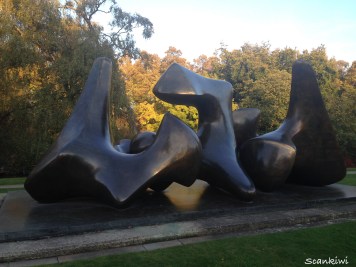
On the banks of the lake I found a park with this amazing bronze sculpture by Henry Moore called “Large Vertebrae” from 1967/68.  Must be the biologist in me.

Henry Moores scuplture Verterbrae

Anyway, walking tour of the city over, time to head to the hotel and treat myself to a lovely last night dinner before getting some rest for the final leg back to Sweden and home.  As I wandered through suburbia, I was struck by just how reminiscent it was of a residential street in Christchurch or Dunedin back home.  Night, night!


Posted in Germany | Tagged , , , , , , , | 1 Comment

Day 5 – Part 2: The Dusk Ceremony at Polygon Wood

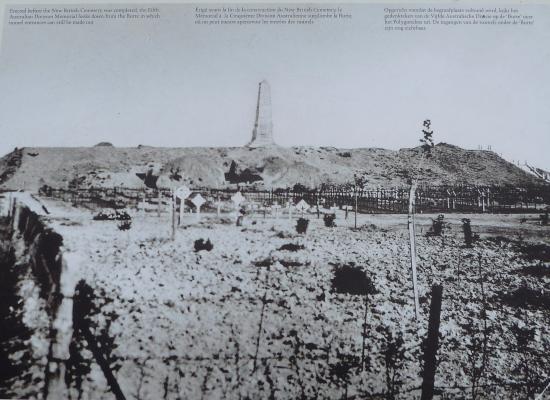
The Butte Polygon Wood with the Australian Memorial and cemetery

Having attended the morning ceremony at Tyne Cot, the cuzzies departed for Ypres and some sightseeing around the local area.  I headed back to Hooge for some lunch and a visit to the local WWI museum beside my hotel.  The plan was to grab some lunch, take it easy and rest up before the evening ceremony at the CWGC Polygon Wood New Zealand Memorial to the Missing.  It was promised to be a special event.

The Hooge Carter Museum is a quaint little WWI museum located in an old church opposite the Hooge Crater Cemetery.  It was a chance to grab some lunch and then have a wander around the museum.  Over lunch I meet a British couple that I had helped up at Tyne Cot Cemetery to find a grave they were looking for.  We got to talking and it turned out they had decided to make a spontaneous trip from England (only 2 hours away by ferry) to Flanders to visit a relative’s grave at Tyne Cot on the anniversary of his birthday and their wedding anniversary.  Unbeknownst to them the very day they would visit the cemetery, NZ would be commemorating the Battle of Passchendaele.  They were greatly moved by the ceremony and the unique New Zealand-ness of it.  Following lunch I took a wander around the museum.  It was packed to the gunnels with finds from the local area most of which were collected within a 500 metre radius of here.  A friendly informative little museum and you could spent hours digging through all the detailed exhibits and still not see everything as I found out.  Time had raced away and I needed to head back to the security area again in order to board a buss to Polygon Wood for the evening’s commemorations.

Polygon Wood is situated in the middle of what was the front on the Ypres Salient running between Messines and Passchendale.  It was also part of the big push all along the Western front in the Summer/Autumn offensive of 1917.  The Battle for Polygon Wood took place during the second phase of the 3rd Battle of Ypres and was fought between 26th of September and the 3rd October 1917.  Polygon Wood was a large forested area with a huge butte (French for small hill).  Much of the woodland was destroyed by the huge quantity of shellfire from both sides, and from July to October 1917 the area had changed hands several times.  The butte with its steep embanked sides provided panoramic views of the surrounding area for who ever held it.  General Herbert Plumer continued the series of British attacks of skirmishers along the line, followed by small infantry columns and creeping barrages.  The plan was that the Anzac Corps would make the main attack on the remainder of Polygon Wood and the southern part of Zonnebeke village in two stages, 730–820 m to the Butte and Tokio pillbox and after a one-hour pause for consolidation, make a final advance beyond the Flandern I Stellung and the Tokio spur.  The large mound in Polygon Wood, the Butte de Polygone gave observation of the east end of the Gheluvelt Plateau towards Becelaere and Broodseinde and the surrounding German trenches and machine gun pillboxes.

Though smaller than in 1917, Polygon Wood today is still large; the remains of three German pillboxes captured by the Australians lie deep among the trees.  The Butte is still prominent and today mounted on top of it is the 5th Australian Divisional Memorial.  There are two CWGC cemeteries in the vicinity of Polygon Wood, the Polygon Wood Cemetery and the Buttes New British Cemetery.  Within the Buttes New British Cemetery is the Polygon Wood New Zealand Memorial to the Missing where the evening’s commemorations would take place.  Before the commemorations began, I once again took the opportunity to put poppies on the graves of the soldiers whose names now adorn the Roll of Honour in the Gore RSA.

The sunset ceremony took the form of a musical tribute.  It was based around a theme of Christmas in the trenches far from home and included the powerful musical composition of Sergeant-Major Dwayne Blommfield’s “Passchendaele,” which includes 6 movements – Barrage, Reflection, Slaughter, Aftermath, Grief & Requiem. Powerful!

The entire evening ceremony can be viewed on the NZ Defence Force channel on YouTube by clicking on the following link: Passchendaele Sunset Ceremony 12 Oct 17.

Leaving the cemetery in the moon light and wandering through Polygon Wood in the darkness was quite eerie after the dramatic musical evening we had experienced and knowing what went on here 100 years ago.  As we got to the road it was somewhat chaotic in the darkness trying to find buses and get back to town.  After what seemed like hours, I was finally back.  I jumped in the car and headed off in the Flanders countryside to a restaurant where my cousins were.  It was my last chance to catch up with them before we parted ways as they headed to Southern Germany tomorrow and I headed to Münster and Northern Germany.

Dinner over!  Time to say bye to Bronwyn, Aimee & Kelsie (see you in NZ) and Steve & Cathy (hopefully see you in Sweden soon), and so my visit to Flanders and my step back in time to the carnage of the First World War was over.  Tomorrow, I would begin my two day journey back to Sweden.

Posted in Belgium, Flanders | Tagged , , , , , , , , | Leave a comment

Day 5 – Part 1: “Our Darkest Hour”

The Battle Fields of Passchendaele

“Our Darkest Hour” – The Centennial Commemorations of the Battle of Passchendaele, Tyne Cot Cemetery, Belgium


For the past 4 years the world has been commemorating the events of World War I (WWI) and New Zealand has been no exception.  The Kiwi commemorations began on the 25th of April 2014 at dawn on the beaches of ANZAC cove in Gallipoli, Turkey marking our entrance into world affairs on the global stage as part of the landing force invading the Dardanelles in WWI.  The commemorations have continued since then marking all the major events in which New Zealand has taken part.  The chance came to participate in the centennial commemorations of the Battle of Passchendaele on the 12th of October 2017, or as we know it “Our Darkest Hour.”

For those of you who do not know or may be asking the question why is this important: The Battle of Passchendaele is particularly poignant for New Zealand and its history.  It is often said to be our defining moment when we become a country instead of a colony of the British Empire.  The 12th of October is remembered as the darkest hour in our short military history.  The day the greatest number of New Zealand soldiers were killed and wounded in a single day.  The failed attack on Bellevue Spur left 843 kiwi soldiers dead and some 2 735 wounded in 12 hours, later a further 130 died of their wounds.
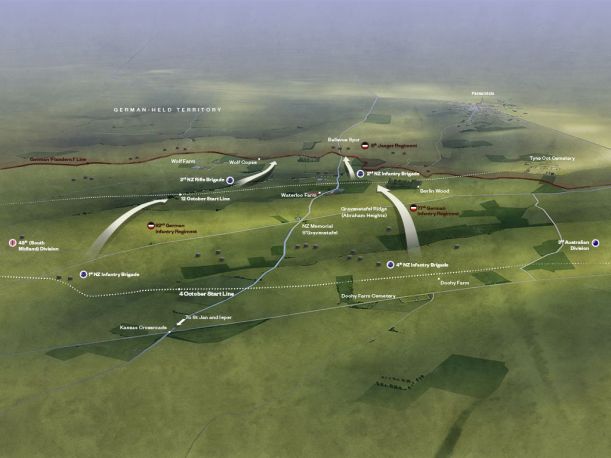
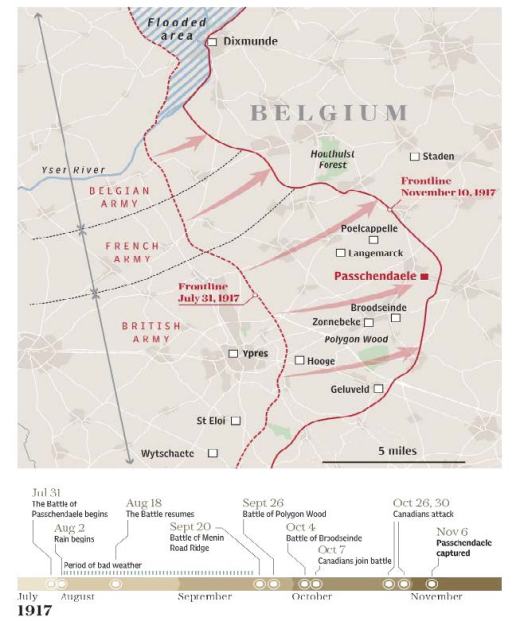
The battle map of Passchendaele

Our day began in the car park at the local amusement park beside my hotel where I met up with the cousins.  Here we had to clear security checks before boarding buses which would transport us the 7 km to Tyne Cot Cemetery for the commemorations.  The security was tight as the services would be attended by HRH Prince William, Duke of Cambridge and HRH Princess Astrid of the Belgians, Arch Duchess of Austria-Este.  The commemorations would also be attended by prominent representatives from New Zealand, Britain and Belgium unfortunately the Governor-General elected to pass on attending as she had been here earlier for the commemorations of Messines Ridge.  In the party besides the royals, were the NZ ambassador to Belgium Greg Andrews, the Speaker of the NZ Parliament, David Carter, the Chief of our Defence forces Lieutenant-General Tim Keating, VC recipient Willie Apiata and the Mayor of Auckland Phil Goff.
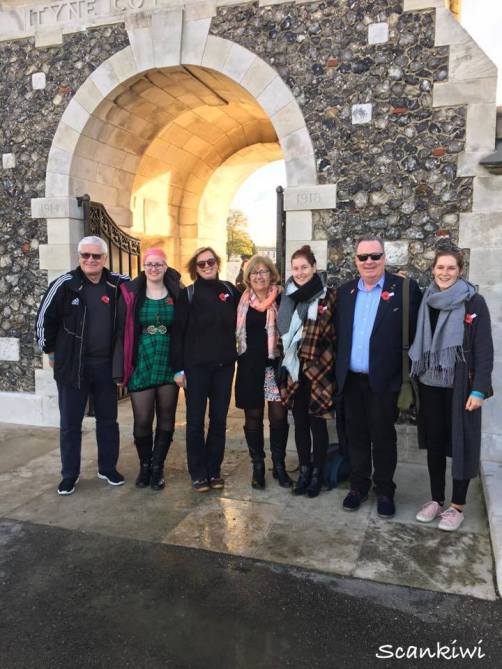
The Connells (L to R Steve, Jess, Cath, Bronwyn, Kelsie, Hugh-John, Aimee)

The cemetery

Tyne Cot Commonwealth War Graves Cemetery and Memorial to the Missing is a Commonwealth War Graves Commission (CWGC) burial ground for the dead of the WWI in the Ypres Salient on the Western Front.  It is the largest cemetery for Commonwealth forces in the world, for any war.  The cemetery and its surrounding memorial are located outside of Passchendaele, near Zonnebeke in Belgium.  The name “Tyne Cot” is said to come from the Northumberland Fusiliers, who on seeing a resemblance between the many German concrete pill boxes on this site and the typical Tyneside workers’ cottages (Tyne cots). Tyne Cot Cemetery lies on a broad rise in the landscape which overlooks the surrounding countryside. As such, the location was strategically important to both sides fighting in the area. The concrete shelters which still stand in various parts of the cemetery were part of a fortified position of the German Flandern I Stellung, which played an important tactical role during the Battle of Passchendaele in 1917.

On 4th October 1917, the area where Tyne Cot Cemetery is now located, was captured by the 3rd Australian Division and the New Zealand Division and two days later a cemetery for British and Canadian war dead was begun.  The cemetery was recaptured by German forces on the 13th April 1918 and was finally liberated by Belgian forces on the 28th of September 1918.
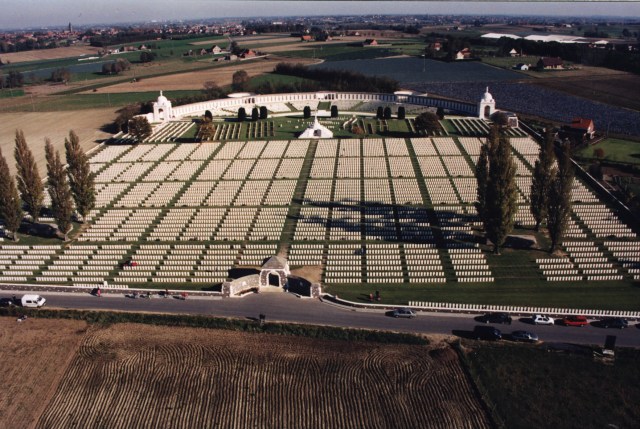
Aerial view of Tyne Cot Cemetery

After the Armistice in November 1918, the cemetery was greatly enlarged from its original 343 graves by concentrating graves from the battlefields and smaller cemeteries nearby.  The cemetery grounds were assigned to the United Kingdom in perpetuity by King Albert I of Belgium in recognition of the sacrifices made by the British Empire in the defence and liberation of Belgium during the war.

The Cross of Sacrifice that marks many CWGC cemeteries was built on top of a German pill box in the centre of the cemetery, purportedly at the suggestion of King George V, who visited the cemetery in 1922 as it neared completion.  The King’s speech included the following in which he said:

We can truly say that the whole circuit of the Earth is girdled with the graves of our dead.  In the course of my pilgrimage, I have many times asked myself whether there can be more potent advocates of peace upon Earth through the years to come, than this massed multitude of silent witnesses to the desolation of war.

— King George V, 11 May 1922

Upon completion of the Menin Gate, builders discovered it was not large enough to contain all the names as originally planned.  They selected an arbitrary cut-off date of the 15th August 1917 and the names of the missing after this date were inscribed on the Tyne Cot Memorial instead.  The New Zealand contingent of the CWGC declined to have its missing soldiers names listed on the main memorials, choosing instead to have names listed near to the appropriate battles.  Tyne Cot was chosen as one of these locations.  Unlike the other New Zealand memorials to its missing, the Tyne Cot New Zealand Memorial to the missing is integrated within the larger Tyne Cot Memorial, forming a central apse in the main memorial wall.  The inscription reads: “Here are recorded the names of officers and men of New Zealand who fell in the Battle of Broodseinde and the First Battle of Passchendaele October 1917 and whose graves are known only unto God”.  The cemetery has 11,965 graves, of which 8,369 are unnamed and the Memorial contains the names of 33,783 soldiers of the UK forces, plus a further 1,176 New Zealanders.

The Battle we commemorate.

The First Battle of Passchendaele (3rd Battle of Ypres Salient) on the 12th of October was another Allied attempt to gain ground around Passchendaele.  Heavy rain and mud again made movement difficult and little artillery could be brought close to the front. Allied troops were exhausted and morale had fallen. After a modest British advance, German counter-attacks recovered most of the ground lost at Passchendaele.

On the 12th of October 1917, it was planned that the 3rd Australian Division would attack Passchendaele ridge and the village, and the New Zealand Division would capture the Bellevue Spur about 13 km outside Ypres.  They were to push the Germans back about 2 km to allow the capture of the village of Passchendaele.  The New Zealand Division contained two attacking brigades each with a machine-gun company and three other machine-gun companies maintaining a machine-gun barrage.  The division had the support of one-hundred and forty-four 18-pounder field guns and forty-eight 4.5 inch howitzers.  The artillery was expected to move forward after the final objective was achieved, to bombard German-held ground from positions 1-2 km beyond Passchendaele village.
LLN-2017-0069(1)

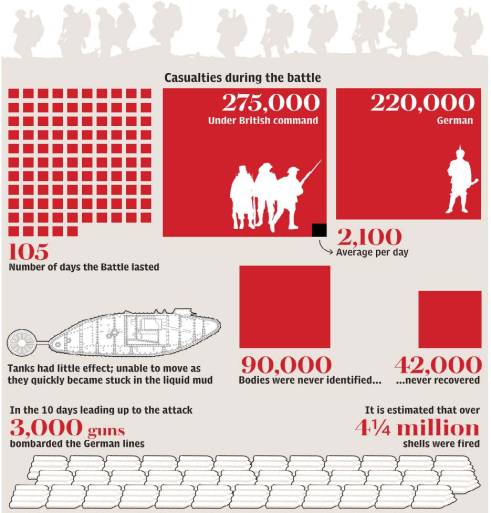
Plans well laid but the rain had fallen all night long on the 11th & 12th of October saturating the terrain to be attacked and turning it into a bog making movement difficult (the summer/autumn of 1917 had been the wettest in over 30 years).  The Germans opposite the New Zealanders had been alert all night, sending up flares and conducting an artillery bombardment (including gas) on the New Zealand front line from 5.00 am which hit the New Zealand trench mortar personnel and destroyed their ammunition.  The New Zealand advance was obstructed by uncut barbed wire and German machine-gun pillboxes.  The creeping barrage from the field-guns was almost absent as the guns were bogged down while others had been knocked out by German artillery.  The creeping barrage diminished as they moved forward and howitzer shells plunging into wet ground around the Bellevue pillboxes, exploded harmlessly because the mud smothered the high-explosive shell-detonations.

The German artillery could fire all the way to the rear of the New Zealand Divisional area and the machine-gun barrages from the German pillboxes raked the advance.  They were caught between both.  The division gained some ground but was stopped by the constant need to cross barbed wire 20–45 m deep while constantly being raked by machine-gun fire.  The British tried an artillery bombardment to support the attack but the shells fell short dropping on some of the New Zealand positions.  They were being bombarded not only by the Germans but their own forces as well.  By the end of the day the NZ troops were forced to retreat and the area they had taken during the day was lost to the Germans.  The resulting carnage had left 843 Kiwi soldiers dead and some 2 735 wounded.  In places, the mud was so deep that men who were wounded and fell, sank into the mud and drowned.  Medics who tried to retrieve the wounded would often become bogged down up to their waist in mud unable to move.

In March 1918, British Prime Minister, David Lloyd George, wrote in his war memoirs that “Passchendaele was indeed one of the greatest disasters of the war […] No soldier of any intelligence now defends this senseless campaign.”

In 1920, the war reporter Philip Gibbs—who had himself witnessed the Third Ypres Battle—wrote that “…nothing that has been written is more than the pale image of the abomination of those battlefields, and that no pen or brush has yet achieved the picture of that Armageddon in which so many of our men perished”.

In 2007, Glyn Harper wrote that “…. more New Zealanders were killed or maimed in these few short hours than on any other day in the nation’s history.”
LLN-2017-0069(2)

The Ceremony 100 years later.

The ceremony began at 11 am with the arrival of HRH Prince William and HRH Princess Astrid who were lead through the cemetery by the NZ Defence Force Maori Culture Party to the Central Apse in the Memorial Wall containing the names of the New Zealand dead.  A key element which would be a leading theme through the ceremony was to be the Kiwi music and Maori traditions.  The original regimental colours of the 4th Otago Southland Battalion from the battle were present.

The Speaker of the New Zealand Parliament, David Carter lead the speeches describing New Zealand in 1914, the dedication of its people, and its entrance into the war on the beaches of Gallipoli, the massive loss of life and the heroism shown there before they were withdrawn and redeployed to the battlefields of France and Belgium.  Their subsequent participation in the Battles of Arras, Somme, Messines and Broodseinde leading up to Passchendaele.  He would go on to clarified why the Battle of Passchendaele would go on to be known as our “darkest hour”.  While the other battles would be remembered for their victories, Passchendaele would always represent a black chapter in our military history by the sheer carnage and loss of NZ live in such a few short hours, and the unbelievable heroism shown by those who survived.  He would offer the greetings and thanks our tiny nation to those Kiwis who made the ultimate sacrifice and who never returned to their homeland reminding them that they will never be forgotten.

HRH Prince William followed David Carter highlighting the cost NZ paid in young men’s lives.  Almost 60% of the 100,000 New Zealanders who went to war became casualties.  More than 18,000 died of wounds or disease — 12,483 of them in France and Belgium. From a population of little more than a million people in 1914, this meant that about one in four New Zealand men between the ages of 20 and 45 was either killed or wounded.  Horrific figures for a little nation at the uttermost ends of the earth.  He too would also thanks to them from a grateful British nation.

HRH Princess Astrid in her speech would highlight the role NZ women played who gave up their sons, the NZ women in the Medical Core who served and lost their lives and the women of New Zealand who collected and sent food and clothing to save the Belgians from starvation.  She referred to her grandmother Queen Elisabeth who had actively visited and worked with the nursing units at the front and her experiences in meeting the Kiwi nurses.  She later created the Queen Elisabeth Medal to recognise exceptional services to Belgium in the relief of the suffering of its citizens during the WWI.  Many NZ women received the medal.  The Princess also reiterated the thanks and gratefulness of the Belgium people to that little nation on the other side of the earth who few had heard of and who had sacrificed so much.
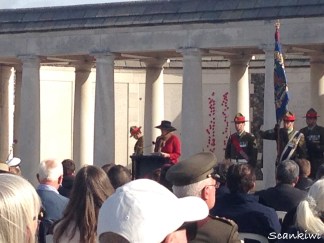
HRH Princess Astrid of Belgium

The final speech was given by the Chief of our Defence forces Lieutenant-General Tim Keating.  He would touch on the traumas of the battle, not just for the soldiers but also the poor Belgians caught in between.  He would highlight the traumas of the NZ commanders and their inability to influence the slaughter.  He would mention the ritual guilt they suffered and the re-examination of decision making while trying to influence decisions and battle plans with limited effect.  For those who did challenge their superiors were summarily relieved and replaced by those who would carry out the orders without question.  Before the disastrous attack of the 12th of October, NZ senior offices were worried about the prospects for the operation.  The Commander of the NZ artillery division Brigadier-General Napier Johnston, wrote in his diary on the eve of the 12th of October that: “…the generals could not depend on the artillery tomorrow. I do not feel confident, things are rushed too much, the weather is rotten, the roads are very bad and the objectives have not been properly bombarded.”  The day after the disastrous battle and its failure he wrote: “…today has been a bad day for us.  My opinion is that the senior Generals who direct these operations are not conversant with the conditions – mud, cold, rain and no shelter for the men, and finally the Germans are not as played out as the make out.”  The Commander of the NZ Division, Major-General Sir Andrew Russell had built the NZ division from the shreds of Gallipoli to one of the best Divisions on the Western Front responsible for a large number of the Allied successes.  He was well respected by his men but felt the full responsibility for the disaster, and was the only man in the command structure to admit the mistake.  It would haunt him for the rest of his life and at times render him an invalid.  Today we would call that Post-traumatic stress disorder (PTSD).
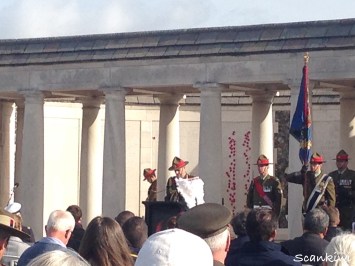
Lt-Gen Tim Keating

Each speech was followed by well known New Zealand music adding a touch of home and with a tug at the old heart strings adding to the sombre emotions of the moment.  When the song “Poppies and Pohutukawa” was sung I don’t think there were many who didn’t shed a tear as the lyrics summed up the feeling for these men who never saw home again.  As the remembrance ceremony drew to a close, wreaths were laid by Belgians and New Zealanders alike, the ode was said and the trumpets sounded out the Last Post over the thousands who were laid to rest here and remembered on the walls.

Poppies and Pohutukawa

The entire ceremony can be viewed on the NZ Defence force channel on YouTube by clicking on the following link: Passchendaele National Commemoration 12th Oct 2017

A moment for personal dedication & reflection

Both my parental and maternal families were not spared these horrors. My paternal (and my cousins too) grandmother had a brother (Tim Flynn) and a cousin (Michael Flynn) who participated in this battle.  Her brother returned a broken man and her cousin is missing in action in the fields of Flanders.  My mother’s great uncle, Andrew O’Brien also fell on the same day and is also missing in action in the fields of Flanders alongside Michael.

Bronwyn and I  were able to visit the NZ Apse in the Memorial Wall to the dead prior to the ceremony where we were able to see Andrew’s and Michael’s names engraved on the wall of remembrance for those who fell but have no known grave.  We were able to mark their names with a poppy and remind them they were not forgotten even though they were 18 821 km from home.

Andrew joined up in October 1915 and arrived in France in March 1916 where he served with the 3rd Battalion NZ Rifle Brigade (known as the Dinks).  He had served 2 years on the Western Front and may have been involved in both the Battle of the Somme and Messines Ridge before he died at the Battle of Passchendaele in the area known as Abraham Heights on the 12th of October 1917 aged 35.  Michael served with the Otago Infantry Regiment and had barely served 6 months on the Western Front when he was killed on the 17th of October aged 35 also in the area of Abraham Heights.  He joined up in September 1916 but in November 1916 contracted Spanish Influenza and almost did not go overseas.  He recovered and was shipped out, arriving in France in March 1917.  In the battle, the Otago Infantry Regiment took over the advanced positions held by the 3rd Rifle Brigade (Andrew’s brigade) after the Passchendaele attack, extending approximately from the cemetery (white cross on map) up towards Berlin Wood.  Michael’s regiment was the one to relieve Andrew’s regiment on the 14th of October.
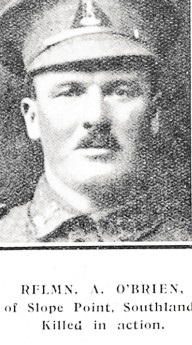
A J O'Brien

We acquired some interesting information while at the commemoration.  Steve had the luck to sit by a women from Auckland who was actively involved with research into WWI.  In friendly conversation, she asked what connections we had to the battle and Michael & Andrew came up.  With a few quick flicks on her iPad she had found their records.  Unfortunately, there was very little information regarding Andrew but we learned quite a bit more about Michael.  He wasn’t just missing in action, he had been found and buried as his records show (see picture), “…grave close by the front line, cross was erected, grave fell into German hands and is now lost..”  Michael may well have been buried in the area of the white cross on the map but the cemetery would later be raised at Tyne Cot (see square in bottom picture).  He may well be one of the 8,369 unnamed graves in Tyne Cot.

After tending to our own relatives I also added poppies to those names I had on my list from the Gore RSA Roll of Honour.  I found the Otago Regiment had been well visited with almost all the names having poppies placed on them and I was able to fill in a few more.  There must have been a large contingent visiting from the Otago/Southland area compared to the other areas of NZ and their Regiment panels.  As I moved around the panel placing the poppies an English gentleman come up to me and inquired as to my connections with the wall.  As the conversation progressed and I told him of Andrew & Michael and the Gore RSA Roll of Honour and I keep thinking, I know your face but just can’t place the name.  He expressed a genuine interest in their stories and in the Southern area of NZ which had not visited.  Anyway the conversation concluded and he moved on to talk to others who were also tending to the names on the wall.  It bugged me that I could not place who he was for the life of me.  It was not until the ceremony began and when he was introduced that I realised who he was…Princess Anne’s husband Vice-Admiral Sir Tim Lawrence, deputy chairman of the CWGC!  At times my memory for names and faces evades me – early signs of old age?

I also tended to the graves on my list while wandering around the cemetery.  The NZ Aspe is just a small colonnade in the long memorial wall.  From the top of the Cross of Sacrifice (on top of a German pill box) you obtain magnificent views over the cemetery and surrounding landscape where most of these soldiers fell within not more than a few hundred metres from here.  Within the grounds of the cemetery there are at least 3 other German pillboxes.

Time to depart and get some lunch and rest before attending the evening ceremony at Polygon Wood.  As I was about to board a buss back to town, a mad little Belgian Policeman began shouting “Royals! Royals! ” and ushered the bus away before we could get on and around the corner of the narrow country lane comes Prince William’s and Princess Astrid’s limos.  It was a case of suck in the belly and pull in your feet or something is going to get run over. 🙂


Posted in Belgium, Flanders | Tagged , , , , , , , , , | Leave a comment

SIDE NOTE: The trenches from hell

As I had mentioned in a previous post: My hotel Hotel Ieper Kasteelhof’t Hooghe was located in Hooge about 4 km outside Ypres and I was to discover that the hotel was actually on the site of the old stable buildings to the original Château de Hooge (home of the Baron de Vinck) on the Bellewaerde Ridge.  The ridge had been the site of intense and sustained fighting between German and Allied forces for the entirety of the WWI.  The following table illustrates some of the major moments during that fighting.

1914

The British had their Headquarters here.

30th October 1914

Six British staff officers were killed by shellfire whilst in a conference at the chateau.

21st February 1915

The Germans exploded an underground mine at Hooge.

May 1915

The chateau was captured by the Germans for the first time.

19th July 1915

The British exploded an underground mine which left a crater 16 metres deep and 40 metres across. A specially formed tunnelling company had burrowed 65 metres to a position beneath a German strong-point and planted nearly two tonnes of Ammonal, the most powerful explosive of the time. The crater was immediately rushed and occupied by the British infantry. Today the crater is a small lake just in front of the hotel.

30th July 1915

The Germans, using flamethrowers, captured the crater and adjacent trenches. This was the first use of flamethrowers against British troops.

9th August 1915

Despite heavy losses the British succeeded in recapturing the crater although the shattered remains of the chateau, only a hundred metres away, remained in German hands.

25th September 1915

A British attack at Hooge failed at a cost of some 4000 casualties.

6th June 1916

As part of a larger attack and with the detonation of four more underground mines, the Germans captured all the British positions at Hooge.

Night of the 12th July 1917

Mustard Gas was used by the Germans for the first time.

31st July 1917

The start of the Third Battle of Ypres. Hooge was recaptured by the British.

21st March 1918

As part of their Spring Offensive the Germans recaptured Hooge and almost took Ypres.

28th September 1918

Hooge was captured for the last time by the British 86th Brigade, under the overall command of the King of the Belgians and pushed the Germans eastwards towards Germany and the Armistice.

The summer of 1915 must have been horrific with the constant back and forwards nature of the fighting here. The ground lost and gained was no more than 100 metres with the horrific cost of lives (4000 in one day in September 1915).  The site witnessed some of the most abominable moments in industrialised warfare.  The first use of flame throwers, underground mines (see also my post “The victory at Messines Ridge“) and the first use of those terrible weapons of mass destruction – mustard & chlorine gas.

And here sits my hotel! What a place.

Why do I bring this up, well the grounds of the hotel were littered with well preserved remains of the trench warfare that took place here.  The beautiful little lake in front of the hotel is actually the crater of the largest of the underground mines exploded here.  The area around the hotel has been turned into an open air museum where you can wander and appreciate the scale of the madness.  In places the opposing trenches were only 15 metres apart.  Angled out of the ground in places are the remains of the mortars used to fire the gas cylinders.  Decaying ammunition (inactive) litters the area.  Digging in the ground is strictly forbidden as the ground is filled with human remains.  This equates for me on the same scale as the killing fields of Cambodia I visited in 2014.

You cannot wander sites like this and not be affected.  Unfathomable to me – the blind madness of it all.  How could commanders like Field Marshall Haig commit 100s of thousands of soldiers to such atrocious conditions with horrific outcomes – the philosophy of the war of attrition.  It boogles the mind to think they believed this was they way to win the war against industrialised weapons.  However, I should not be surprised, as the only qualification you needed at the time to be a commanding officer in the high command seemed to be that you were a born member of the British aristocracy.  No wonder the NZ commanders felt frustrated at not being allowed to lead their men and influence the battle strategies, and having to answer the orders of incompetent British aristocrats.  However, when left to carry out tasks assigned to them without interference from the high command the ANZACs achieved some of the major breakthroughs of the war through their own initiatives (e.g. Messines Ridge).

Frustrating and noble thoughts while standing amid the remnants of such carnage.  How could the recruiters of the time sell this to the lads down under as “a chance to see the world”.  Easy for me to stand here 100 years later with my noble thoughts and critise, I was simply wasn’t around at that time.  Glad I wasn’t, but it made me cry to think of all those young men in their twenties who never got to enjoy the benefits and advantages of the life I have had.

With this myriad of thoughts in my head I was glad to get out the trenches and to cross the road to the Hooge Crater Cemetery and pay my respects once again.  I would be haunted by these trenches for the rest of my stay as my room was just 10 metres from them and as I drew the curtains every morning I would look straight in to them.

Posted in Belgium, Flanders | Tagged , , , , , | Leave a comment

Day 4 – Part 2: Ypres & The Menin Gate

Having returned from Messines Ridge where I spent the morning, I decided to spend the rest of the day having a look around Ypres (Ieper) before the ceremony in the evening at the Menin Gate. Now Ypres was the arrival and dispersal point for the soldiers arriving to the Western Front and was the last stop before they headed out to the trenches across Flanders.

Ypres is the centre of the Flanders and the Flemish area of Europe in the south western corner of Belgium.  The city is located almost on the French border about 50 km from the coast, Dunkirk and the English Channel, and dates back to Roman times.  As can be seen, it lies at a strategic crossroads controlling access to ports and the coast.  It has always had a strong connection to the English providing them with linen and cloth through the centuries. It was been occupied by just about everybody…French, Spanish, Germans, Austrians…the poor Flemish have not had it easy, an explanation to why the town is surrounded by large city walls and a wide moat.

The city like most trading cities is build up around the central square. Occupying and dominating the square is the impressive “Cloth Hall” from the 13th century where all the merchants stored and traded their linen.  It is said, that during the witch hunts that cats  being the symbol of the devil and witchcraft, were thrown off Cloth Hall, possibly in the belief that this would get rid of evil demons (poor pussy cats 😦 ). A different theory is that cats were held to protect the cloth against mice, but the annual excess of kittens had to be dealt with in some way.  Today, this act is commemorated with a triennial Cat Parade through the town. Today, Cloth Hall contains the international peace museum – “In Flanders Fields”. The museum not only preserves the memories of what happened in Flanders fields but has a mission to also research and convey as much as it can about what happened.  Behind the Cloth Hall is St. Martin’s Cathedral also dating from the 13th century.  It houses the grave of Robert the III, Count of Flanders but also affectionately known as the “The Loin of Flanders” for resisting the rule of the French in the 1300s.  The Cathedral and Cloth Hall were heavily damaged by German WWI bombardment, however, both have been faithfully restored/reconstructed during the 1920s and 30s.

Continuing my wander around the town, I headed up to the old fish market (Vismarkt) with its Toll house. From there on up to the market square with its Town Hall, stopping along the way to purchase some Belgian Chocolates at Peter de Groots and some Belgian beers to take home, before finally arriving at the Menin Gate.

The Menin Gate is a memorial to all the British and Commonwealth soldiers who are missing in action after the battles of WWI in and around Ypres who have no known graves with the exception of the New Zealanders who have their memorial at Tyne Cot cemetery.  The memorial is located at the eastern exit of the town and marks the starting point for one of the main roads out of the town that led Allied soldiers to the front line.  The eastern exit was simply cut through the remains of the ramparts and across the moat.  Many who past through this exit never returned with some 300,000 of them being killed in the Ypres Salient and 90,000 of these soldiers with no known graves.  The Menin Gate as we see it today was designed in 1921.  Its large Hall of Memory contains names on stone panels of 54,395 Commonwealth soldiers who died in the Salient but whose bodies have never been identified or found. On completion of the memorial, it was discovered to be too small to contain all the names as originally planned. An arbitrary cut-off point of 15 August 1917 was chosen and the names of 34,984 of the missing after this date were inscribed on the Tyne Cot Memorial to the Missing instead.

To this day, the remains of missing soldiers are still found in the countryside around Ypres. Such finds are made during building work or road-mending activities. Any human remains discovered receive a proper burial in one of the war cemeteries in the region. If the remains can be identified, the relevant name is removed from the Menin Gate and added to their headstone in the cemetery.  Following the Menin Gate Memorial opening in 1927, the citizens of Ypres wanted to express their gratitude towards those who had given their lives for Belgium’s freedom. Hence every evening at 8pm, buglers from the Last Post Association close the road which passes under the memorial and sound the “Last Post“.  With the exception of the German occupation in WWII, this ceremony has been carried out every night uninterrupted since 2 July 1928.

On the eve of the commemorations of the 100th Anniversary of the Battle of Passchendaele, the citizens of Ypres had accorded New Zealand the honour of dedicating the Last Post ceremony on the 11th of October to the Kiwis who had fallen to protected their beloved Flanders even though no Kiwi names adorn the memorial.  The 11th of October saw many leave through this exit preparing for the battle which was to come on the 12th of October 1917.  During the day as I had passed through the city, people on learning you were a New Zealander would come up, smile, say hello, some would even shake your hand and thank you for the sacrifice NZ made in defending this small part of their country.  The sight of the fern and the poppy on my lapel was enough for them to open their hearts in welcome.  Fantastic generosity to citizens from a country as far as you can get from theirs.  Moving.  As the evening drew in, I was joined once again by my cousins.

As I had mentioned in an earlier post, I meet a group of Kiwis at the Messines Ridge Memorial yesterday who said they were here to paddle the waka in the evening ceremony at the Menin Gate  The evening ceremony of the Last Post was proceeded by a light show on the ramparts of Ypres called “From the uttermost ends of the earth” with the waka taking part in it.  It was a moving picture, light and sound show before the public moved inside the gate for the “Last Post” ceremony.  The ceremony was both sombre and joyful and definitely very Kiwi.  From the thundering sounds of the haka, Dave Dobbyns beautiful rendition of his hit song “Welcome home”, to the many waiatas (Maori Songs) which echoed within the beautiful acoustics of the gate to amplify the emotions fell by all in remembering what had happened to our soldiers 100 years ago.  Not a dry eye in the house.  As the evening drew to a close we retired to a local pub to enjoy a beer with the locals and enjoy the moment we had just experienced.

A short film of the ceremony can be found on Youtube by clicking on this link: “From the uttermost ends of the earth!

Posted in Belgium, Flanders | Tagged , , , , , , , , , | Leave a comment

Day 4 – Part 1: The Victory on Messines Ridge

Up at the crack of dawn, going to be a busy day. Over breakfast I met a charming mother and daughter who were over for the commemorations from NZ. They were with a tour group but unfortunately there wasn’t enough room at the inn so they were billeted at my hotel. It was great to have some company as there was a noisy group of German business men in who just wouldn’t shut up.

Breakfast over, I headed about 20 km south towards the French border to the site of another battle which preceded Passchendaele and in which the Kiwi soldiers played a decisive role in June 1917 – The Battle of Messines.  Messines Ridge was one of the highest points along the western front with dominating views of the surrounding area, and had been held by the Germans for most of the war.  The attack was a precursor to the much larger 3rd battle of Ypres to come a few months later – Passchendaele.  In preparing for the Messines battle, 21 mine shafts were laid underneath German lines all along the ridge, All 22 to be detonated at zero hour 03:10 on the 7th of June 1917, to be followed by infantry attacks so as to secure the ridge from the dazed German defenders.  The infantry would be heavily supported by the use of artillery bombardments, tanks and the use of gas.  Work on laying the mines began some 18 months before zero hour.  General Plumer remarked to his staff the evening before the attack, “Gentlemen, we may not make history tomorrow, but we shall certainly change the geography.”

Heavy artillery bombardment of the German lines begun on 21st May, involving 2,300 guns and 300 heavy mortars, ceasing only at 02:50 on the morning of the 7th of June, 17 days later.  The German troops, sensing imminent attack, rushed to their defensive positions, machine guns ready, meanwhile sending up flares to detect British movement towards the ridge.  At 03:10, the order was given across the line to detonate the mines, which totaled 600 tons of explosive. Of the 21 mines laid 19 exploded.

The effect of the mines was colossal!  They blew the crest off the Messines ridge.  The explosion was audible in Dublin (870 kms away) and by the British Prime Minister Lloyd George in his Downing Street office in London.  The combined sound of the simultaneous mine explosions comprised the loudest man-made explosion until that point.  The lighting up of the sky as the detonations ran across the ridge was likened to a ‘pillar of fire’.  The effect of the mine explosions upon the German defenders was devastating.  Some 10,000 men were killed instantly during the explosion.

With the Aussies on the right, the British on the left, the New Zealand Battalion charged the centre.  Within 3 hours all the major goals were achieved and then some, but with heavy casualties for the NZers – 3000 wounded and 700 dead.  However, this was considered a major victory for the Allies and the first major success of the war after 3 years of stalemate and it was all down mostly to the ANZACs.

Wandering along the ridge it was easy to see the commanding views the Germans had of the areas and the uphill battle the ANZACs had.  The size of the crates after the mines are massive and can still be seen today. The biggest one Hill 60 is almost 80 metres deep.

I made a visit first to the NZ Memorial Messines at the top of the ridge where the Kiwis came up.  Then moved onto the Messines Ridge (New Zealand) Memorial with the names of the missing at the entrance to the Messines Ridge British Cemetery.  Here I was again able to mark the names of several soldiers on the Gore RSA Roll of Honour with poppies.  While wandering around the cemetery I run into the Maori group who would be paddling the Maori waka at the Menin Gate ceremony in the evening. It was good to have a chat, hear the kiwi accent and catch up from news back home.  I also paid a visit to Messine town square where there stands a bronze statue of a NZ soldier erected by the people to thank the Kiwis for what they did. They even named one of the streets after New Zealand.  Also visiting the square was the statue commemorating Christmas eve 1917 where the Kiwis & Germans came out of their trenches to meet in no-mans land, wish each other a Merry Christmas, exchange small gifts of food & cigarettes and to play a little football only to retire back to their trenches and start killing each other the next day.

From Messines I headed down to the end of the ridge to Ploegsteert Wood (Plug Street Wood).  After fierce fighting in late 1914 and early 1915, Ploegsteert Wood became a quiet sector where not much action took place. Units were sent here to recuperate and retrain after tougher fighting elsewhere and before returning to take part in more active operations.  Most of those who died here did not die in major offensives, such as those which took place around Ypres to the north. Most were killed in the course of the day-to-day trench warfare or wounded who died in the field dressing station here.  Nearby in Ploegsteert Wood were the ‘Catacombs’ or deep shelters capable of holding two battalions where soldiers could rest up between battles.

I visited Strand Military Cemetery on the road from Ploegsteert to Armentieres, again to visit some graves for the RSA back home.  Here lye a lot of casualties from the dressing station, most of the burials are unidentified but there are special memorials to those whose graves were destroyed by shell fire in other areas.  The cemetery fell into the hands of the Germans towards the end of the war so it has some German graves also.  I made a quick stop also at the Berks Cemetery Extension in Ploegsteert. Beautiful cupola memorial to the Berkshire regiments but I also found NZ soldiers were also buried here.

With the morning visit over and in need of lunch I headed back to spent the afternoon exploring Ypres before the evening ceremony at the Menin Gate.

Posted in Belgium, Flanders | Tagged , , , , , | Leave a comment

Day 3 – Part 2: Ghent & Cuzzies

After spending the the morning at Hooge Crater and Lijssenthoek Military Cemeteries I was ready for a break. I left Lijssenthoek with reflections and emotions I had not experienced before and they filled my thoughts as I headed the 90 km to Ghent to meet my cousins.

The GPS got me into the city in time for lunch then it was just to find a car park and try and find my cousins. Little did I know I would have the luck of the Irish and randomly choose to park right outside the building they were eating lunch in. Odds of that in a city of canals and 250 000 people? Steve, Cathy & Jess live in the UK and I have had the chance to meet them over the years but Bron and her daughters Aimee & Kelsie live in NZ. I hadn’t seen Bron in almost 20 years, Aimee a bit more recently at uni, and I had never meet Kelsie at all. Reunions were made over lunch and then we headed out to explore this UNESCO marked city from the middle ages.

Ghent is a city of canals like Amsterdam and it was a major trading centre with direct access to Bruges and the sea and inland via the canals. It became famous as a centre of wool trading and later for its lace. During the First and Second world Wars Ghent was occupied by the Germans but thankfully escaped severe attack so all the original buildings are intact. It is famed for its hanseatic architecture and guildhalls of the merchants along the canals.

We took a self-guided walking tour through the old merchant quarters and markets crisscrossing the canals and cobbled streets.  It was in one of the back streets Bron and her daughters found a mode of transport they thought was uniquely adapted for their family to get around town.

Eventually we arrived in the centre at the Castle of the Counts built in 1180. The castle was built by Philip of Alsace after his return from the Second Crusade and he wanted to remind the town’s inhabitants who was boss. An impressive and picturesque structure little changed from that time.

As the sun was beginning to go down and a need to rest the legs, the girls suggested we take a canal boat ride to continue seeing the sites. Armed with some Belgian chocolate we boarded a boat for what turned out to be a lovely hour in the setting autumn sun.

After the boat ride, some headed off for a rest at the hostel while Bron, Aimee, Kelsie and I headed off to add more to the parking for the car before exploring more of the city centre. Surprisingly, we found some autumn strawberries which were unexpectedly sweet and delicious for this time of year in Europe. We settled into a vegan cafe before heading back to their hostel for a tapas styled dinner accompanied with some beer and wine.

I must say their hostel was very imaginative for a hostel.  It was inside an old industry building on the canal. Inside the building, some of the rooms were actually old caravans decorated in rather unconventional ways complete with outdoor furniture.  Everything was recycled or should I say up-cycled.  A novel and interesting form of accommodation.  As the evening drew to a close it was time for me to hit the road back to Ypres, as it would take an hour to get back and there was another full day booked for tomorrow.  The cuzzies decided they would come down to Ypres and stay and join me at the commemorations.

Posted in Belgium, Ghent | Tagged , , , | Leave a comment

Day 3 – Part 1: The Fallen

Woke to a relatively clear and warm morning. The warmer temperatures here are a contrast to the cold ones I left in Scandinavia. I also found a message waiting for me on Facebook and it simply read, “Are you here?” It was from my cousin informing me that his wife Cath, their daughter Jess and his sister Bronwyn with her two daughters Aimee & Kelsey were in Brugge only 45 km away. What a surprise! Bronwyn was visiting from NZ so they decided they would take her across the channel from the UK to Belgium & Germany.  They were moving on to Ghent in the afternoon and it was decided I would join them later in the day. So plans for the day were laid and I headed out to make my first visit to the battle sites of Flanders.

Day 3

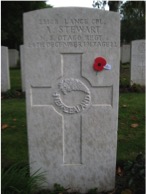
Now when I had been back in NZ in June, I had promised our local Returned Serviceman’s Association (RSA) in Gore that if possible I would lay poppies and photograph the graves and memorials of those soldiers who fell in Flanders who were listed on their Roll of Honour, some of whom had never been visited by family members because of distance and economy.  I would also be making a visit to the memorial at Tyne Cot in 2 days time for the Centennial Commemorations of the Battle of Passchendaele, where maternal and paternal family members are remembered who had fallen in the battle.

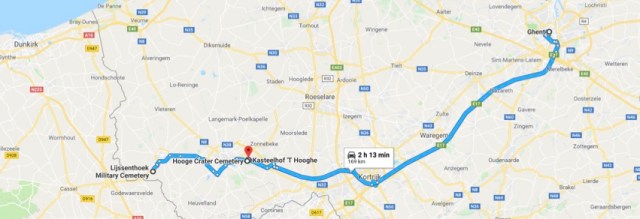
My hotel was located in Hooge about 4 km outside Ypres and I was to discover the hotel was actually the stable buildings to the original Château de Hooge on the Bellewaerde Ridge which had been the site of intense and sustained fighting between German and Allied forces for the entirety of the war (I will actually have a separate post in my blog on this later). The first cemetery I would visit was across the road from the hotel – the Hooge Crater Cemetery.

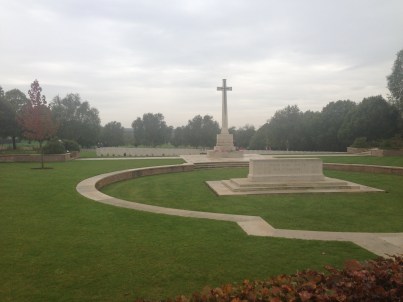
The Hooge Crater Cemetery is a Commonwealth War Graves Commission (CWGC) cemetery and is named after a land mine crater which was blown nearby in 1915.  Many of the dead from the battles for Bellewaerde Ridge, the Château de Hooge and the land mine explosion are buried here including 3 from the Gore (2 352 in all). Sadly, one of them dying on Christmas Eve 1917.

171010 002HCC graveHooge Crater Cemetery

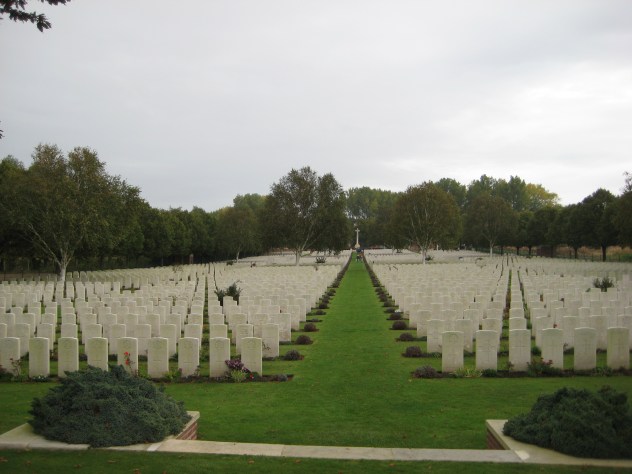
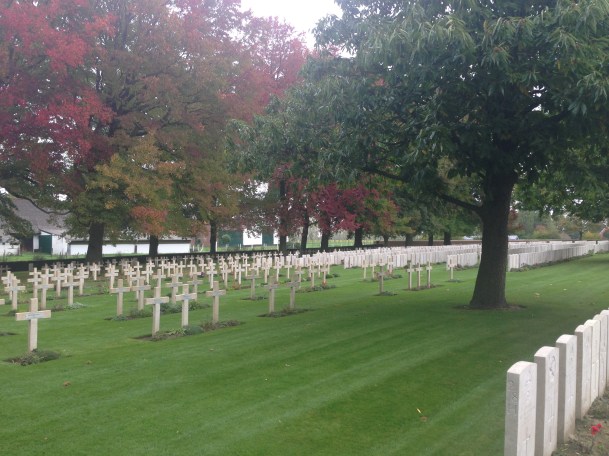
Next it was on to Lijssenthoek Military Cemetary about 8 km west of Ypres. It is a CWGC burial ground and after Tyne Cot, it is the second largest cemetery for Commonwealth forces in Belgium with some 10 121 graves. Lijssenthoek was the location for a number of casualty clearing stations during the First World War. The village was situated on the main communication line between the Allied military bases in the rear and the Ypres battlefields. Close to the Front, but out of the extreme range of most German field artillery. The cemetery had not only graves for the Commonwealth soldiers but also for the French, German and Chinese.  Here I found 7 graves from the Roll of Honour in Gore.

Lij panorama Lij French gravesLijssenthoek Military Cemetery

My reflections on the having visited these sites thus far I will defer until later in a dedicated post. I left Lijssenthoek with reflections and emotions I had not experienced before and they filled my thoughts as I headed the 90 kms to Ghent to meet my cousins.

Posted in Belgium, Flanders | Tagged , , , | Leave a comment

Day 2 – Bremen to Ypres

Awoke to a beautiful sunny morning in Bremen which boded well for the trip ahead. Fully loaded after breakfast and with a full tank of petrol on board, it was out on to the A1 for the 670 km, 6-6.5 hour trip to Ypres in Flanders.  It is always nice to begin the day with such optimism for you never know what lies ahead.  This leg would be a longer than yesterday taking me past Münster where I will be staying on the way back, on past Dortmund and crossing the Rhine on the northern side av Cologne before crossing the border into Belgium south of Aachen.  Then it would be a straight run west direct to Brussels and the famed Brussels ring, hopefully hitting it before rush hour, then continuing west to Ghent before turning once again south and passing into Flanders and finally Ypres.

Oh such well laid plans!

Everything held together for the first 3 hours, but as I neared Leverkusen I noticed the traffic was beginning to thin out. It must have been my inattention or lack of German that I may have missed some important road works notices for with a sudden abruptness I come to a complete stop at the Leverkusen bridge over the river Rhine (closed for repairs). I was forced off the autobahn into the city centre. It was at this point I got into a fight with my GPS who was trying to force me back onto the closed bridge. In the end I won by turning it off. The only thing left was to find a road parallel to the river and head along it until I found a bridge to cross. I chose to head north towards Düsseldorf and after about 40km I finally found a bridge. Later I would learn that if I had headed south 10kms I would have been able to cross in Cologne. Grrrr!

Having lost an hour trying to get across the Rhine I finally turned the GPS back on.  Everything seemed back on track although slightly off track and I settled in for a calming run to the Belgian border.  While taking a leg stretch after having successfully got across the Rhine an hour before, I decided to check the map at the pit stop. Not good news! I was heading directly west into Holland. Grrr! Belgium and where I was heading was south west and the current route would add another 1.5 to 2 hours to the trip. This is where “Anders” on my GPS and I had a big falling out and he was consigned to the glove box and Iphone maps got his chance. Within 5 minutes he had me back on track although it would involve many country back roads to get me across country to the right autobahn. Another 40 minutes lost!

Finally I was back on track but those 2 hours lost meant I would be hitting the Brussels ring at peak hour, so it was peddle to the metal and see what time I could make up. From the Belgian border to the Brussels ring it was almost dead straight for 150 km.  While making up time buzzing along at 140-150 kph, I was never going to beat rush hour on the ring so I found myself spending 1 hour on the ring to travel a piddly 20km. Grrr! Once clear of the ring and a stop to fill up with petrol it was back on the motorway and the final 120 km till Ypres.

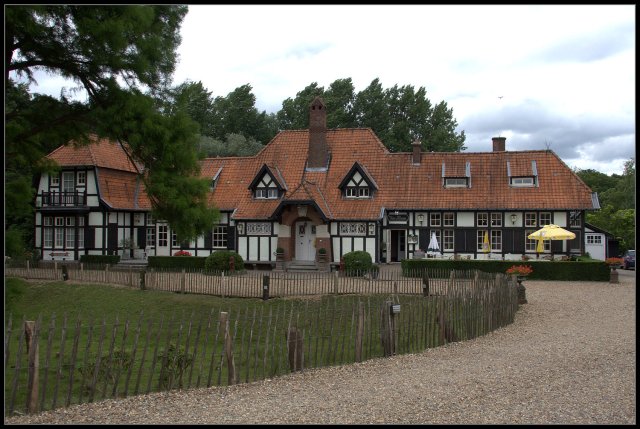
Night had fallen by the time I arrived into my hotel Kasteelhof ‘T Hooghe at 7.30pm in the evening. Ten hours after leaving Bremen on what was suppose to be a 6-6.5 hour trip. It was a beautiful cross-timber hotel in the countryside about 4 km outside Ypres.  Not much more to do other than get something to eat and a beer to wash away the road weariness and then some well earned rest.

I am here, so now I can enjoy what I came for! Night, night!

IMG_4211

Posted in Belgium, Flanders | Tagged , , , , , | Leave a comment

Day 1 – Malmö to Bremen

With the car packed and ready, it was off at 9 am on the 468 km leg to Bremen. passing through Sweden, Denmark to Germany while crossing the 16 km Öresund bridge from Sweden to Denmark and a 1 hour ferry trip between Denmark and Germany.  It took about 2 hours to reach the ferry so it was a perfect chance to take a break and stretch the legs on the ferry crossing. Once on German soil it was onto the Autobahns. Set the cruise control to 140 kph and barrel along as the countryside flashes by. Cruising along at 140 kph I was definitely not in the fast lane. Thought I would leave that to the super cars who flashed by at regular intervals as though I was standing still. However, we were all forced down to a modest speed of 60 kph as we negotiated the myriad of roadworks surrounding Hamburg.

I duly arrived in Bremen around 3 pm to bright sunshine and a temperature of around 18 degrees. A distinct contrast to the 7 degrees I left in Malmö. After checking into the Hotel Stadt Bremen Garni it was out into the sunshine and enjoy a chance to see this old hanseatic (meaning: a medieval merchant guild or trade association) city from the 1300s. It is an inland port located on the Weser River 65 km from the coast hence why it was popular as a trade centre in the Hanseatic guild.

First stop was the town square with its famed Ratshaus (town hall) from the 1600s; its St. Petri Dom (St Peter’s cathedral) from the 1200s; and Bremen’s Roland. Now Bremen’s Roland is a famed statue of liberty from the 1400s. There are Roland statues in many German towns and cities, symbolising freedom and market rights but this is the largest.

From the city square it was a short walk up to Bremen’s oldest district, the Schnoor quarter, with its maze of lanes filled with tiny little 15th and 16th century houses & shops.  The name of the area may allude to the fact that the houses are lined up like pearls on a string (schnoor meaning string or rope in German).

From there I went of in search of Bremen’s famous town musicians – a donkey, a dog, a cat and a rooster.  An unlikely musical combination I know but it refers to the fairy tale by the Grimm brothers about 4 animals who were getting old and who ran away to Bremen to be musicians and avoid being put down by their masters. I remember reading this one in a book of the Grimm Brothers fairy tales that Mum had won in a Plunket raffle back in the 60s and which I still think is circulating in the family with the grandchildren.

The gist of the story is they ran off together. In the night they arrived at a little house looking for shelter but it was full of robbers.  They decided to chase the robbers off so they could sleep there the night. The donkey put his front hooves on the window ledge, the dog jumped on the donkey’s back, the cat climbed on the dog and the rooster flew up and sat on the cat’s head. They began to play their music: the donkey brayed, the dog barked, the cat meowed and the cock crew. Then they all fell through the window into the room, shattering the glass as they went. The robbers got such a fright at the terrible noise, and thinking it was a ghost, fled into the woods. With the robbers gone the 4 friends settled down for the night. Now the robbers seeing the house all quiet and in darkness suspected the ghost had gone, so the leader sent one of the robbers to check it out. He went inside but unfortunately for him he woke the animals. The cat spat and scratched his face, the dog bit him on the leg, the donkey kicked him as he went past and the rooster screeched at the top of his head. The robber fled back to his group and told the gang the house was inhabited by a witch who spat on him and scratched his face with her long fingers; and by the door there was a man who stabbed his leg; and in the farmyard there is a black monster which attacked him with a wooden club; and on the roof there is a judge who called out “bring the scoundrel to me”.  From that time on the robbers did not dare go near the house but the four friends liked it so much that they didn’t want to leave, and they all lived happily ever after.

And here they are immortalised as a bronze statue by the city hall.

After patting the animals I headed on down through Böttcherstrasse towards the river to enjoy a beer in the setting sun at one of the many restaurants & bars lining the river bank. Along the way I passed the famed carillon in consisting of 30 Meissen porcelain bells which play a mixture of sea shanties and traditional folk songs to the visitors amusement. Once ensconced at a local bar it was time for some food and a good German beer in the setting sun before heading back to the hotel to get some shut eye before tomorrow next leg of the journey to Ypres.

The Wesser River bank

Posted in Germany | Tagged , , , , , , | Leave a comment